The 'Friends of Marcia Powell' are autonomous groups and individuals engaging in prisoner outreach, informal advocacy, and organized protest and direct actions in a sustained campaign to: promote prisoner rights and welfare in America; engage the Arizona public in a creative and thoughtful critique of our system of "justice;” deconstruct the prison industrial complex; and dismantle this racist, classist patriarchy...

Retiring "Free Marcia Powell"

As of December 2, 2010 (with occasional exceptions) I'm retiring this blog to direct more of my time and energy into prisoner rights and my other blogs; I just can't do anyone justice when spread so thin. I'll keep the site open so folks can search the archives and use the links, but won't be updating it with new posts. If you're looking for the latest, try Arizona Prison Watch. Most of the pieces posted here were cross-posted to one or both of those sites already.

Thanks for visiting. Peace out - Peg.
Showing posts with label human rights. Show all posts

Tuesday, March 8, 2011

International Sex Workers' Rights Day: March 3, 2011.


In memory of Marcia Powell,
and all our other brothers and sisters dying out there...


--------------


SEX WORKERS and HUMAN RIGHTS
: Best Practices


Report on The United States of America 9th Round of the Universal Periodic Review – November 2010

1. This report is submitted by the Best Practices Policy Project, Desiree Alliance, and the Sexual Rights Initiative. It focuses on civil and human rights violations of those engaged, or perceived to be engaged, in sexual trade and sex work in the U.S.

Background and Context

2. People involved in sexual trade or sex work in the U.S. are found in a wide array of settings and circumstances; perform a variety of services; and communicate with clients through clubs, on the street, through newspapers, phonebooks, and the internet. They include people of all gender identities who work in clubs, in brothels, in their or other’s homes, in hotels, outdoors, and in other spaces. While sex work is generally stigmatized and aspects of it criminalized, street-based or outdoor workers, transgender or gender non-conforming people, people of color, migrants, and youth consistently bear a particularly heavy burden of police abuse and harassment, institutional discrimination, and violence.

3. Stigmatization of sex workers and those profiled as such in tandem with “zero-tolerance” policing in urban areas where poorer communities are being displaced, operate to ensure that these populations are disproportionately impacted by the prison system. Sex workers in these areas face additional burdens of police violence and abuse. Arrests for sex work can lead to a cycle of continued exclusion from housing and other job opportunities, and to re-imprisonment. Furthermore, because many forms of sex work in the U.S. are treated as a crime, law enforcement officials frequently fail to recognize that sex workers can be victims of crime, and thus deny justice or support to sex workers who seek their help.

Legal and Institutional Framework

4. Criminal prohibition of sex for money and surrounding activities exists in most states (with the exception of some counties in the state of Nevada). Some forms of sex work, such as exotic dancing, may not be prohibited by state legislation but they are always regulated by state and municipal policies. Sex work that occurs in public spaces is also often policed under legislation prohibiting loitering, public nuisance, trespassing or “failure to obey” a police officer’s directive to move along. More states in the U.S. are now mandating minimum sentences so that judges are required to give people convicted for prostitution-related offenses jail time and some states have sentencing guidelines and judicial practices which make a third charge for prostitution-related offenses a felony.

5. While the United States has only ratified a few of the major U.N. human rights treaties, (the Convention on the Elimination of All Forms of Racial Discrimination (CERD), International Covenant on Civil and Political Rights (ICCPR), the Convention against Torture (CAT), and the Convention on the Rights of the Child (CRC), these treaties have direct bearing on sex workers’ human rights. These include: the right to be free from discrimination; freedom from torture, cruel, inhuman and degrading treatment; the right to healthcare; and the right to equal protection under the law.

The Right to Equal Protection under the Law


6. Sex workers of color in the United States are disproportionately targeted by the police for arrest because of their minority status, violating the U.S. Constitution, international standards against discrimination and treaties such as CERD and ICCPR. Furthermore, people of color from the lowest income communities who do sex work in public spaces to meet their most urgent and immediate needs, are relentlessly and disproportionately targeted by the police. Arrest and subsequent conviction for prostitution and prostitution-related offenses intensifies the homelessness or housing precariousness experienced by people from low-income communities because people with criminal records are barred from accessing, or may lose, their public housing.

7. Transgender women, especially those of color, in the United States are profiled, targeted, harassed, cited and/or falsely arrested by the police as sex workers for simply walking outside. Male sex workers may be harassed by the police in part because of homophobia and women sex workers who are perceived to step outside of traditional female roles (e.g. by failing to be subservient) may be disproportionately targeted for arrest. Gender based discrimination against women and gender non-conforming people violating their right to equal protection under the law is reinforced by anti-prostitution legislation. For example, legislation enacting “Prostitution Free Zones,” areas in which police may move along and arrest people who they believe to be prostitutes, erode legal protections barring officers from detaining individuals on the basis of how they are perceived or the way they are dressed.

8. Another particularly discriminatory practice by state agents is sex offender registration of people convicted for sex work related offenses. In some parts of the U.S., these sex workers are registered as sex offenders for ten years and must carry an identification card with “sex offender” stamped on it, among other penalties. The majority of people sentenced this way are African-American and almost all are women and transgender women. They then face discrimination from employers, housing agents and are unable to qualify for education loans, making it impossible to secure even menial, low-wage work. Because they become completely shut out from other forms of work, many people who are registered as “sex offenders” have no other option but to continue in sex work, potentially returning to prison after subsequent arrests.

9. Many people engaged in sexual exchange, particularly street-based workers, face violence, including assault and rape, and numerous sex workers are murdered each year. The notion that sex workers are “disposable” may be the root cause of this violence. The legal establishment does not conceive that sexual workers can be sexually assaulted and may obstruct sex workers’ attempts to seek justice for crimes committed against them. Such violations of sex workers’ rights lead to a lack of faith in the State providing them with adequate promotion and protection of their lawful human rights, including protection from violence. Furthermore, sex workers fear further harm, humiliation, and/or arrest when turning to the authorities for assistance. Youth thought to be engaged in the sex trade face discrimination and neglect from a wide range of institutions, including hospitals, shelters, treatment centers, Child and Family Services agencies, and law enforcement agencies.

10. Migrant sex workers face the double burden of stigmatization for working in criminalized labor sectors and for their immigrant status. A portion of migrant sex workers are undocumented but even if migrants have correct immigration paperwork, engaging in sex work can both invalidate visas causing deportation and prevent entry into the United States. Anti-prostitution laws can therefore become a tool for immigration officials seeking to deport migrants: recently police have begun arresting large numbers of Latinas, charging them with prostitution related offenses leading to their deportation. When arrested or in court immigrants are often not provided with an interpreter, so they may be completely unaware of the charges brought against them and/or the need for attendance at follow up court dates significantly impacting on their access to criminal justice.

11. Misguided U.S. law and policy addressing trafficking in persons makes the lives of migrant sex workers more difficult. Migrant workers may be arrested, detained and subsequently deported in “raid and rescue” missions carried out by local law enforcement and federal immigration authorities. The current prosecution-oriented approach to anti-trafficking work in the US also traumatizes trafficked persons. People trafficked into the sex sector in the United States are forced to comply with law enforcement and endure possible “re-victimization” in order to get benefits and status. Migrant sex workers have become increasingly wary of service providers because of the operation of some anti-trafficking organizations that have provided information about work places to law enforcement authorities leading to raids, arrest and deportation. U.S. anti-trafficking policies undermine the health and rights of sex workers both domestically and internationally by requiring that organizations seeking funding adopt a policy against sex work (“anti-prostitution pledge”).

Freedom from torture, and other cruel, inhuman and degrading treatment

12. U.S. sex workers’ greatest fear is abuse by the police and other state agents. Organizations working with sex workers have documented a pattern of practice by police towards sex workers, which includes assault, sexual harassment and rape that constitutes torture and cruel, inhuman and degrading treatment. Street sex workers and other people who are often profiled as prostitutes (such as transgender women) are very frequently subjected to this kind of treatment. When sex workers seek recourse for crimes committed against them, officers do not take their reports seriously or may further violate these sex workers by arresting them, physically assaulting them or pressuring them for sex.

The Right to Adequate Health Care


13. Criminalization, marginalization and stigma prevent sex workers from enjoying their right to health by undermining their access to adequate health care and the conditions in which they live and work. The U.S. Government has failed to ensure adequate access to health services and support for sex workers. They are not provided with HIV prevention and education services that would help them protect their own health and the health of their customers. Furthermore, policing directly undermines sex workers’ ability to prevent the transmission of HIV and other sexually transmitted infections because of the widespread law enforcement practice of using condoms as evidence and/or destroying condoms and safe sex materials.

14. Sex workers in the United States are very unlikely to discuss their work with medical providers because of fears about how they will be treated in addition to their fears of the law. These fears are based on real lived experiences. Sex workers who approach police with severe injuries from violence perpetrated against them are routinely belittled and blamed for the attacks against them and are not escorted, or even referred, to emergency rooms. Further, individuals in medical facilities seeking care for injuries sustained from attacks against them who are profiled as sex workers have been accusatorily questioned by police prior to receiving medical care. Sex worker friendly services providers capable of addressing the full range of their health needs (reproductive health care, sexual health, counseling, assistance with domestic violence, etc) are few and far between in the United States and significantly under-funded. Many mainstream service providers are not prepared to understand sex workers’ needs; services for men in sex work are extremely limited.

Recommendations

The United States of America should:

15. Implement rigorous training of law enforcement officials on legal and human rights standards with regards to sex work. e.g. police training on issues relating to gender, race, ethnicity, age and addressing crimes that may be committed against sex workers including the importance of referring victims of crime to rape crisis and trauma support agencies.

16. Institute mechanisms that allow sex workers to find redress for human rights violations and hold law enforcement accountable for their actions, e.g. officers who subject sex workers to degrading treatment and abuse, must be subject to appropriate disciplinary procedures. Sex workers must be able to report police misconduct and violence while being protected from retaliation.

17. Repeal laws, including laws against prostitution and prostitution-related offenses, and eliminate policies, such as “zero tolerance” of prostitution, “prostitution free zones,” and “quality of life” measures, that undermine protection and respect for human rights of sex workers, people in the sex trade and other marginalized groups. Sex workers should also be able to expunge any criminal records relating to these laws.

18. Repeal the application of felony-level charges and mandatory minimum sentencing against people arrested for sex work and expunge the records of those arrested and charged under these laws.

19. Remove any and all sex offender registration requirements of those arrested for engaging in prostitution or “unnatural copulation,” and expunge the records of those arrested for sex work and charged under laws that mandate sex offender registration.

20. Change policies that prevent sex workers from applying for and/or receiving student loans and public housing.

21. Invest resources in education, job training, healthcare, and housing programs for marginalized people engaged in sex work and the sex trade. Specifically, funding for low-income communities and communities of color should be allocated to provide job training, education programs, apprenticeships, healthcare, and housing opportunities;

22. Provide funding for harm reduction and rights based health care services for male, female, and transgender sex workers. Lift all restrictions on federal funding for harm reduction programs.

23. Prohibit agencies that receive public funding from discriminating against people engaged in sex work or in the sex trade.

24. Immediately end the law enforcement practice of using possession of condoms and other safe sex supplies as evidence of a crime.

25. Provide comprehensive services and legal support for migrant sex workers, including language interpretation in the criminal justice system.

26. Reorient anti-trafficking campaigns to be in line with the standards set by the UN High Commissioner on Human Rights.

27. Repeal and remove “anti-prostitution pledge” requirements for U.S. Global AIDS Funds and anti-trafficking funds.

Friday, December 31, 2010

New Year's Eve Parade of Fools: 2010.


Just came from the Fiesta Bowl parade in Phoenix. The signs facing the two AZ politicians below say "Stop Prisoner Abuse" (on "defend Human Rights") and "for a Happier New Year" (at my feet).
..


joe arpaio


jan brewer

Thursday, December 16, 2010

Georgia Prisoners transform dialogue on Civil Rights: Strike update.


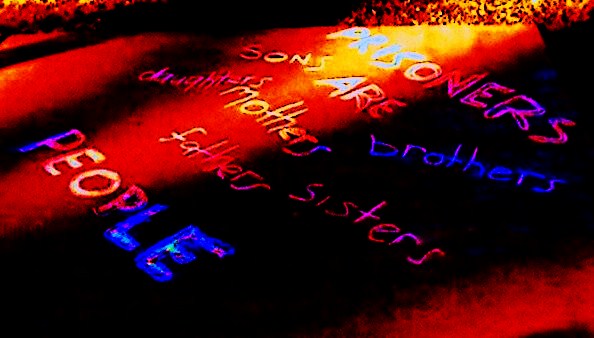
"Prisoners are people, too..."

AZ State Capitol Complex/Wes Bolin Plaza, Phoenix.
(Thanksgiving, 2009)


The above chalking was my holiday gift to the prisoners maintaining state grounds who had to clean up after me last year once I discovered this form of free speech was legal. Feel free to download and distribute - I've made postcards out of it to mail to prisoners, politicians and media alike in the past year. It's still a good present.

The following update comes from the Black Agenda Report yesterday, via Claude at the Freedom Archives' Political Prisoner News list-serve. Both are awesome sources of information about prisoner rights and activism.

Members of the public should continue to call the Georgia DOC numbers below - let them know we're still watching, and that we expect these prisoners to be treated with respect. The rest of us could learn something from their courageous resistance to the brutality and violence of incarceration in America.


-----------------------------------------------


By The Editors
Created 12/15/2010 - 14:40
Submitted by The Editors on Wed, 12/15/2010 - 14:40
Story by Bruce A. Dixon, audio interview by Glen Ford


Georgia prisoners who began a courageous, peaceful and nonviolent protest strike for educational opportunities, wages for their work, medical care and human rights have captured the attention of the world. Black Agenda Report intends to closely cover their continuing story. Glen Ford recorded a conversation with activist Elaine Brown and one of the striking inmates in Georgia on Wednesday, December 15.


Updated story on the strike and support efforts of the newly formed Concerned Coalition to Protect Prisoner Rights below the fold. (hit the Black Agenda Report and click the flash player below the article to listen to the interview).


GA Prison Inmate Strike Enters New Phase, Prisoners Demand Human Rights, Education, Wages For Work


Story by Bruce A. Dixon, audio interview by Glen Ford


The historic strike of Georgia prisoners, demanding wages for their labor, educational opportunities, adequate health care and nutrition, and better conditions is entering a new phase. Strikers remain firm in their demands for full human rights, though after several days many have emerged from their cells, if only to take hot showers and hot food. Many of these, however, are still refusing their involuntary and unpaid work assignments.


A group that includes relatives, friends and a broad range of supporters of the prisoners on the outside has emerged. They are seeking to sit down with Georgia correctional officials this week to discuss how some of the just demands of inmates can begin to be implemented. Initially, Georgia-based representatives of this coalition supporting the prisoner demands included the Georgia NAACP, the Nation of Islam, the National Association for Radical Prison Reform, the Green Party of Georgia, and the Ordinary Peoples Society among others. Civil rights attorneys, ministers, community organizations and other prisoner advocates are also joining the group which calls itself the Concerned Coalition to Protect Prisoner Rights.


Prisoners have stood up for themselves, and the communities they came from are lining up to support them. Today, at a ground breaking for a private prison 300 miles southeast of Atlanta in Millen GA, residents of that local community opposed to the private prison are greeting the governor and corrections brass with a protest. They will be joined by dozens more coming in from Atlanta who will respectfully urge state authorities to talk to the prisoners. We understand that one person there has been arrested. Black Agenda Report will have photos and footage of that event on Thursday.


The broad-based Concerned Coalition to Protect Prisoners Rights fully supports the heroic stand of Georgia's prisoners. “This isn't Attica,” one representative of the coalition explained. “No violent acts have been committed by any of the inmates involved. We hope state corrections officials will be as peaceful and respectful as the prisoners have been, and start a good faith dialog about quickly addressing their concerns.”


Right now, the ball is in the hands of state corrections officials, and reports are that in some of the affected prisons, authorities are fumbling that ball, engaging


“They transferred some of the high Muslims here to max already,” one prisoner told Black Agenda Report this morning. “They want to break up the unity we have here. We have the Crips and the Bloods, we have the Muslims, we have the head Mexicans, and we have the Aryans all with a peaceful understanding, all on common ground. We all want to be paid for our work, and we all want education in here. There's people in here who can't even read...


“They're trying to provoke people to violence in here, but we're not letting that happen. We just want our human rights.”


The transfers are intended to deprive groups of leadership and demoralize them. In some cases they may be having the opposite effect, stiffening prisoner morale and making room for still more leaders to emerge.


“The prisoners insist that punitive transfers are an act of bad faith, the opposite of what we should be doing,” said Minister Charles Muhammad, of the Nation of Islam in Atlanta. “The coalition supports them and demands no punitive transfers, either within or between institutions, and absolutely no transfers to institutions outside Georgia.”


Members of the public should continue to call the prisons listed below, and the GA Department of Corrections and the office of Georgia's governor, Sonny Perdue. Ask them firmly but respectfully to resolve the situation non-violently and without punitive measures. Tell them you believe prisoners deserve wages for work and education. Ask them to talk to prisoners and the communities they come from. It's simple. With one in twelve Georgia adults in jail or prison, parole or probation or other court and correctional supervision, prisoners are us. They are our families. They are our fathers and our mothers, our sons and daughters, our nieces and nephews and aunts and uncles and cousins.


Most prisoners will be back out in society sooner, not later. It's time for us all to grow up and realize that warehousing, malnourishing, mistreating and abusing prisoners does not make us safer. Denying prisoners meaningful training and educational opportunities, and forcing them to work for no wages is not the way to do. It's time to fundamentally reconsider prison as we know it, and America's public policy of mass incarceration.


Bruce Dixon and Glen Ford are reachable at bruce.dixon(at)blackagendareport.com and glen.ford(at)blackagendareport.com, respectively. Black Agenda Report intends to provide ongoing coverage several times per week of the ongoing struggle of Georgia prisoners.


The Georgia Department of Corrections is at http://www.dcor.state.ga.us and their phone number is 478-992-5246


Macon State Prison is 978-472-3900


Hays State Prison is at (706) 857-0400


Telfair State prison is 229-868-7721


Baldwin State Prison is at (478) 445- 5218


Valdosta State Prison is 229-333-7900


Smith State Prison is at (912) 654-5000


---------------------------------------

Freedom Archives
522 Valencia Street
San Francisco, CA 94110

415 863-9977


www.Freedomarchives.org

Questions and comments may be sent to claude@freedomarchives.org

Monday, August 2, 2010

BOYCOTT HATE! Don't patronize this State!!!

Here's another shout out from an active reader, responding to the previous post on Prison Abolitionist from Democracy Now's coverage of the SB 1070 protests. That post was put up there for me by my comrade in the Netherlands, since I've been too busy moving, protesting, cop-watching, agitating our Neo-nazis, getting burglarized, and going to prison these past few days to do much of anything with these blogs myself. That's why I have back-up (thank you, dear friend).

Tonight I have a band to go see at Conspire Phoenix, so, sorry all - check out my links to the blogs above for someone else's local radical coverage - all I can say now is that while there are some awesome people here, there's still an abundance of free-flowing nastiness and hate swaggering around this state. These people should be shamed back into donning white hoods, but instead they're running for political office on platforms that promise to erode both the Bill of Rights and the Universal Declaration of Human Rights. They'll probably get elected, too, unless some more good citizens move here and register to vote before the deadline. It's pretty troubling what's been going on down here.


Thanks for your contribution, Montana. Hope the rest of you are boycotting us, America - that's the only reason this place finally decided to honor Martin Luther King Day. More on that issue later this week...right now I need a break from this ugly place.

--------------------------

Montana has left a new comment on your post "Democracy Now: about July 29th 2010 in Arizona":

"House Bill 2013" and "SB1070"

0 = Arizona
2 = USA/ Our Constitution/ We the People of the United States

We are a country that is ruled by the Constitution, Bill of Rights and the Declaration of Independence, not by the majority of the day. When you do not know the principles in these documents, therein lays the problem in losing when you are challenged in court.

This month of July 2010, our U.S. Federal courts have found the so-called State of Arizona hate-filled legislation, namely "House Bill 2013" and "SB1070", un-constitutional (So much for the intellect of Jan Brewer, "Did you read the bills you signed?"). But we all know that they will go crying to the Supreme Court of the United States, please, please, please go. We will fight you in Arizona, any other state, and yes in Washington DC. We will not tire, we will not be silent and we will persevere, I promise you.

In my opinion the Republican Party has been taken over the most extreme of clans; the Baggers, Birthers and Blowhards (people who love to push their beliefs and hate on others while trying to take away the rights of those they just hate) and that's who they need to extract from their party if they really want to win in November. Good Luck, because as they said in WACO, "We Ain't Coming Out".

It's all about politics: Jan Brewer you were never elected to be Governor, but you have no problem trying to get elected on the backs of undocumented workers, you loser (sure, you may win, but the long-term effects to your so-called state is just beginning). Here is a partial list of your hate-filled legislation;

1. S.B. 1070,

2. House Bill 2013

3. No permit concealed weapons law,

4. The famous Birthers law,

5. Banning Ethnic studies law,

6. Could she be behind the Mural in Prescott, Arizona, ordered to be whiten,

7. On deck to pass, no citizenship to babies born to undocumented workers,

8. If she can read she should look up Arizona's House Bill 2779 from two years ago (which was un-constitutional and failed when legally challenged),

9. The boycotted Martin Luther King Day, what idiots don't want another holiday? Yes, you guessed it: Arizona.

Well Arizona, you can keep boycotting new holidays, passing hate filled legislation and the rest of our country will continue to challenge you in court of law and Boycott your so-called state.

Lets face it, no one can really believe anything that comes out of Brewer's mouth, in an interview, this year, in an attempt to gain sympathy, she first said her father had died in Germany fighting the Nazis in World War II (which ended in 1945), but of course we find out the truth that her father was never in Germany and died in California in 1955. But we are supposed to believe everything else she says, right?

As they say in the World Cup: Gooooooooal!

Sunday, May 9, 2010

Mother's Day, Sentencing, and the War on Drugs


Women in Prison: A Fact Sheet
The Issue: Sentencing and the War on Drugs

The Department of Justice found that women were over represented among low level drug offenders who were non-violent, had minimal or no prior criminal history, and were not principal figures in criminal organizations or activities, but nevertheless received sentences similar to “high level” drug offenders under the mandatory sentencing policies. From 1986 to 1996 the number of women sentenced to state prison for drug crimes increased ten-fold. Nationally one in three women in prison and one in four women in jail are incarcerated for violating a drug law. (Department of Justice, Bureau of Justice Statistics Prisoners in 1997)

·  According to The Boston Globe, "nearly 26% of the nearly 2000 men and women crowding Massachusetts prisons for  drug crimes are first-time offenders…. Worse, nearly three out of four drug traffickers who do get charged in major cases, but agree to forfeit substantial drug money to prosecutors, bargain their way out of the long sentences…. The result: those with no money or information to trade face the hard mandatory sentences."

·     From 1986 to 1996, the number of women sentenced to state prison for drug crimes increased from 2,370 to 23,700.  (Bureau of Justice Statistics, Washington DC Prisoners in 1997)

·  In 1986, 12.0% of women in prison were drug offenders. In 1991, 32.8% of women in prison were incarcerated for  drug offenses.  (Women in Prison, Survey of State Prison Inmates, 1991. US Department of Justice, March 1994, NCJ 145321)

The Issue: Sexual Assault and Misconduct Against Women in Prison

The imbalance of power between inmates and guards involves the use of direct physical force and indirect force based on the prisoners’ total dependency on officers for basic necessities and the guards’ ability to withhold privileges. Some women are coerced into sex for favors such as extra
food or personal hygiene products, or to avoid punishment.   

·  Powerlessness and Humiliation
There are 148,200 women in state and federal prisons. In federal women’s correctional facilities, 70% of guards are male.  Records show correctional officials have subjected female inmates to rape, other sexual assault, sexual extortion, and groping during body searches. Male correctional officials watch women undressing, in the shower or the toilet. Male correctional officials retaliate, often brutally, against female inmates who complain about sexual assault and harassment

·  Retaliation and Fear
In many states guards have access to and are encouraged to review the inmates’ personal history files (this includes any  record of complaints against themselves or other prison authorities). Guards threaten the prisoner’s children and visitation rights as a means of silencing the women. Guards issue rule infraction tickets, which extend the woman’s  stay in prison if she speaks out. Prisoners who complain are frequently placed in administration segregation.

·  Impunity 
Ineffective formal procedures, legislation and reporting capacity within US jails and prisons account for much of the  ongoing sexual abuse of women. In 1997, according to the US Justice Department only 10 prison employees in the  entire federal system were disciplined, and only 7 were prosecuted. If a prison official is found guilty, he is often simply transferred (“walked off the yard”) to another facility instead of being fired. The inmate may also be transferred. 

The Issue: Medical Neglect of Women in US Prisons
Women are denied essential medical resources and treatments, especially during times of pregnancy and/or chronic and degenerative diseases.

·  Failure to refer seriously ill inmates for treatment and delays in treatment
Women inmates suffering from treatable diseases such as asthma, diabetes, sickle cell anemia, cancer, late-term miscarriages, and seizures have little or no access to medical attention, sometimes resulting in permanent injury or death. Instances of failure to deliver life-saving drugs for inmates with HIV/AIDS have also been noted.  

·  Lack of qualified personnel and resources and use of non-medical staff
There is too few staff to meet physical and mental health needs. This often results in long delays in obtaining medical attention; disrupted and poor quality treatment causing physical deterioration of prisoners with chronic and degenerative diseases, like cancer; overmedication of prisoners with psychotropic drugs; and lack of mental health treatment. The use of  non-medical staff to screen requests for treatment is also common. 

·  Charges for medical attention
In violation of international standards, many prisons/jails charge inmates for medical attention, arguing that the charge deters prisoners from seeking medical attention for minor matters or because they want to avoid work. In some supermaximum prisons, where prisoners cannot work at all, the US Justice Dept. expressed concern that charging prisoners impedes their access to health care.

·  Inadequate Reproductive Health Care
In 1994, the National Institute of Corrections stated that provision of gynecological services for women in prison is inadequate.  Only half of the state prison systems surveyed offer female-specific services such as mammograms and Pap smears, and often entail a long wait to be seen.

·  Shackling During Pregnancy
Shackling of all prisoners, including pregnant prisoners, is standard policy in federal prisons and in the US Marshall Service and exists in almost all state prisons. Shackling during labor may cause complications during delivery such as hemorrhage or decreased fetal heart rate. If a caesarian section is needed, a delay of even 5 minutes may result in permanent brain damage to the baby.
  
·  Lack of treatment for substance abuse
The gap between services available and treatment needs continues to grow. The number of prisoners with histories of drug abuse is growing, but the proportion of prisoners receiving treatment declined from 40% in 1991 to 18% in 1997.  

·  Lack of Adequate or Appropriate Mental Health Services
 48-88% of women inmates suffer from post-traumatic stress disorder due to sexual or physical abuse experienced prior to coming to prison.  Very few prison systems provide counseling. Women attempting to access mental health services are routinely given medication without opportunity to undergo psychotherapeutic treatment.  


The Issue: Discrimination Based On Gender, Race and Sexual Orientation
The growth in incarceration has had its greatest impact on minorities, particularly African Americans. Women are most vulnerable to different forms of discrimination, including sexual harrasment or abuse. Women that do not fit the “norm”, such as lesbians, are more succeptable to torture and abuse.

Discrimination Based on Race:
·  Over a five-year period, the incarceration rate of African American women increased by 828%. (NAACP LDF Equal Justice Spring 1998.) An African American woman is eight times more likely than a European American woman is to be imprisoned.  African American women make up nearly half of the nation’s female prison population, with most serving sentences for nonviolent drug or property related offenses. 

·  Latina women experience nearly four times the rates of incarceration as European American women.

·  State and federal laws mandate minimum sentences for all drug offenders.  This eliminates the option for judges to refer first time non-violent offenders to drug treatment, counseling and education programs.  The racial disparity revealed by the crack v. powder cocaine sentences insures that more African American women will land in prison.

Although 2/3 of crack users are white or Hispanic, defendants convicted of crack cocaine possession in 1994 were 84.5% African American.  Crack is the only drug that carries a mandatory prison sentence for first time possession in the federal system. 

Discrimination Based On Sexual Orientation:
·   Human Rights Watch has documented categories of women who are likely targets for sexual abuse. Perceived or actual sexual orientation is one of four categories that make a female prisoner a more likely target for sexual abuse, as well as a target for retaliation when she reports that abuse.

·  If a woman is a lesbian, her criminal defense becomes more challenging.  Jurors in the US were polled as to what factors would make them most biased against a defendant, and perceived sexual orientation was chosen as the most likely personal characteristic to bias a juror against a defendant, three times greater than race. (National Law Journal November 2, 1998.)

·  The case of Robin Lucas depicts how sexual identity may subject a woman to further abuse or torture by a guard. She was placed in a men’s prison where male guards allowed male inmates to rape her.  The male guards taunted her about her same sex relationship, saying to her “maybe we can change your mind”.  

For more information on issues affecting women in prison and other women’s human rights issues, please visit the Women’s Human Rights Program website at www.amnestyusa.org/women or contact us at AIUSA 5 Penn Plaza-16th floor, New York, NY 10001 or at (212) 633-4292.

Monday, May 3, 2010

UN: Standard Minimum Rules for the Treatment of Prisoners

Office of the UN High Commissioner for Human Rights:
Standard Minimum Rules for the Treatment of Prisoners

Text in PDF Format

Adopted by the First United Nations Congress on the Prevention of Crime and the Treatment of Offenders, held at Geneva in 1955, and approved by the Economic and Social Council by its resolutions 663 C (XXIV) of 31 July 1957 and 2076 (LXII) of 13 May 1977
PRELIMINARY OBSERVATIONS

1. The following rules are not intended to describe in detail a model system of penal institutions. They seek only, on the basis of the general consensus of contemporary thought and the essential elements of the most adequate systems of today, to set out what is generally accepted as being good principle and practice in the treatment of prisoners and the management of institutions.

2. In view of the great variety of legal, social, economic and geographical conditions of the world, it is evident that not all of the rules are capable of application in all places and at all times. They should, however, serve to stimulate a constant endeavour to overcome practical difficulties in the way of their application, in the knowledge that they represent, as a whole, the minimum conditions which are accepted as suitable by the United Nations.

3. On the other hand, the rules cover a field in which thought is constantly developing. They are not intended to preclude experiment and practices, provided these are in harmony with the principles and seek to further the purposes which derive from the text of the rules as a whole. It will always be justifiable for the central prison administration to authorize departures from the rules in this spirit.

4. (1) Part I of the rules covers the general management of institutions, and is applicable to all categories of prisoners, criminal or civil, untried or convicted, including prisoners subject to "security measures" or corrective measures ordered by the judge.

(2) Part II contains rules applicable only to the special categories dealt with in each section. Nevertheless, the rules under section A, applicable to prisoners under sentence, shall be equally applicable to categories of prisoners dealt with in sections B, C and D, provided they do not conflict with the rules governing those categories and are for their benefit.

5. (1) The rules do not seek to regulate the management of institutions set aside for young persons such as Borstal institutions or correctional schools, but in general part I would be equally applicable in such institutions.

(2) The category of young prisoners should include at least all young persons who come within the jurisdiction of juvenile courts. As a rule, such young persons should not be sentenced to imprisonment.

Part I
RULES OF GENERAL APPLICATION
Basic principle

6. (1) The following rules shall be applied impartially. There shall be no discrimination on grounds of race, colour, sex, language, religion, political or other opinion, national or social origin, property, birth or other status.

(2) On the other hand, it is necessary to respect the religious beliefs and moral precepts of the group to which a prisoner belongs.

Register

7. (1) In every place where persons are imprisoned there shall be kept a bound registration book with numbered pages in which shall be entered in respect of each prisoner received:

( a ) Information concerning his identity;

( b ) The reasons for his commitment and the authority therefor;

( c ) The day and hour of his admission and release.

(2) No person shall be received in an institution without a valid commitment order of which the details shall have been previously entered in the register.

Separation of categories

8. The different categories of prisoners shall be kept in separate institutions or parts of institutions taking account of their sex, age, criminal record, the legal reason for their detention and the necessities of their treatment. Thus,

( a ) Men and women shall so far as possible be detained in separate institutions; in an institution which receives both men and women the whole of the premises allocated to women shall be entirely separate;

( b ) Untried prisoners shall be kept separate from convicted prisoners;

( c ) Persons imprisoned for debt and other civil prisoners shall be kept separate from persons imprisoned by reason of a criminal offence;

( d ) Young prisoners shall be kept separate from adults.

Accommodation

9. (1) Where sleeping accommodation is in individual cells or rooms, each prisoner shall occupy by night a cell or room by himself. If for special reasons, such as temporary overcrowding, it becomes necessary for the central prison administration to make an exception to this rule, it is not desirable to have two prisoners in a cell or room.

(2) Where dormitories are used, they shall be occupied by prisoners carefully selected as being suitable to associate with one another in those conditions. There shall be regular supervision by night, in keeping with the nature of the institution.

10. All accommodation provided for the use of prisoners and in particular all sleeping accommodation shall meet all requirements of health, due regard being paid to climatic conditions and particularly to cubic content of air, minimum floor space, lighting, heating and ventilation.

11. In all places where prisoners are required to live or work,

( a ) The windows shall be large enough to enable the prisoners to read or work by natural light, and shall be so constructed that they can allow the entrance of fresh air whether or not there is artificial ventilation;

( b ) Artificial light shall be provided sufficient for the prisoners to read or work without injury to eyesight.

12. The sanitary installations shall be adequate to enable every prisoner to comply with the needs of nature when necessary and in a clean and decent manner.

13. Adequate bathing and shower installations shall be provided so that every prisoner may be enabled and required to have a bath or shower, at a temperature suitable to the climate, as frequently as necessary for general hygiene according to season and geographical region, but at least once a week in a temperate climate.

14. All parts of an institution regularly used by prisoners shall be properly maintained and kept scrupulously clean at all times.

Personal hygiene

15. Prisoners shall be required to keep their persons clean, and to this end they shall be provided with water and with such toilet articles as are necessary for health and cleanliness.

16. In order that prisoners may maintain a good appearance compatible with their self-respect, facilities shall be provided for the proper care of the hair and beard, and men shall be enabled to shave regularly.

Clothing and bedding

17. (1) Every prisoner who is not allowed to wear his own clothing shall be provided with an outfit of clothing suitable for the climate and adequate to keep him in good health. Such clothing shall in no manner be degrading or humiliating.

(2) All clothing shall be clean and kept in proper condition. Underclothing shall be changed and washed as often as necessary for the maintenance of hygiene.

(3) In exceptional circumstances, whenever a prisoner is removed outside the institution for an authorized purpose, he shall be allowed to wear his own clothing or other inconspicuous clothing.

18. If prisoners are allowed to wear their own clothing, arrangements shall be made on their admission to the institution to ensure that it shall be clean and fit for use.

19. Every prisoner shall, in accordance with local or national standards, be provided with a separate bed, and with separate and sufficient bedding which shall be clean when issued, kept in good order and changed often enough to ensure its cleanliness.

Food

20. (1) Every prisoner shall be provided by the administration at the usual hours with food of nutritional value adequate for health and strength, of wholesome quality and well prepared and served.

(2) Drinking water shall be available to every prisoner whenever he needs it.

Exercise and sport

21. (1) Every prisoner who is not employed in outdoor work shall have at least one hour of suitable exercise in the open air daily if the weather permits.

(2) Young prisoners, and others of suitable age and physique, shall receive physical and recreational training during the period of exercise. To this end space, installations and equipment should be provided.

Medical services

22. (1) At every institution there shall be available the services of at least one qualified medical officer who should have some knowledge of psychiatry. The medical services should be organized in close relationship to the general health administration of the community or nation. They shall include a psychiatric service for the diagnosis and, in proper cases, the treatment of states of mental abnormality.

(2) Sick prisoners who require specialist treatment shall be transferred to specialized institutions or to civil hospitals. Where hospital facilities are provided in an institution, their equipment, furnishings and pharmaceutical supplies shall be proper for the medical care and treatment of sick prisoners, and there shall be a staff of suitable trained officers.

(3) The services of a qualified dental officer shall be available to every prisoner.

23. (1) In women's institutions there shall be special accommodation for all necessary pre-natal and post-natal care and treatment. Arrangements shall be made wherever practicable for children to be born in a hospital outside the institution. If a child is born in prison, this fact shall not be mentioned in the birth certificate.

(2) Where nursing infants are allowed to remain in the institution with their mothers, provision shall be made for a nursery staffed by qualified persons, where the infants shall be placed when they are not in the care of their mothers.

24. The medical officer shall see and examine every prisoner as soon as possible after his admission and thereafter as necessary, with a view particularly to the discovery of physical or mental illness and the taking of all necessary measures; the segregation of prisoners suspected of infectious or contagious conditions; the noting of physical or mental defects which might hamper rehabilitation, and the determination of the physical capacity of every prisoner for work.

25. (1) The medical officer shall have the care of the physical and mental health of the prisoners and should daily see all sick prisoners, all who complain of illness, and any prisoner to whom his attention is specially directed.

(2) The medical officer shall report to the director whenever he considers that a prisoner's physical or mental health has been or will be injuriously affected by continued imprisonment or by any condition of imprisonment.

26. (1) The medical officer shall regularly inspect and advise the director upon:

( a ) The quantity, quality, preparation and service of food;

( b ) The hygiene and cleanliness of the institution and the prisoners;

( c ) The sanitation, heating, lighting and ventilation of the institution;

( d ) The suitability and cleanliness of the prisoners' clothing and bedding;

( e ) The observance of the rules concerning physical education and sports, in cases where there is no technical personnel in charge of these activities.

(2) The director shall take into consideration the reports and advice that the medical officer submits according to rules 25 (2) and 26 and, in case he concurs with the recommendations made, shall take immediate steps to give effect to those recommendations; if they are not within his competence or if he does not concur with them, he shall immediately submit his own report and the advice of the medical officer to higher authority.

Discipline and punishment

27. Discipline and order shall be maintained with firmness, but with no more restriction than is necessary for safe custody and well-ordered community life.

28. (1) No prisoner shall be employed, in the service of the institution, in any disciplinary capacity.

(2) This rule shall not, however, impede the proper functioning of systems based on self-government, under which specified social, educational or sports activities or responsibilities are entrusted, under supervision, to prisoners who are formed into groups for the purposes of treatment.

29. The following shall always be determined by the law or by the regulation of the competent administrative authority:

( a ) Conduct constituting a disciplinary offence;

( b ) The types and duration of punishment which may be inflicted;

( c ) The authority competent to impose such punishment.

30. (1) No prisoner shall be punished except in accordance with the terms of such law or regulation, and never twice for the same offence.

(2) No prisoner shall be punished unless he has been informed of the offence alleged against him and given a proper opportunity of presenting his defence. The competent authority shall conduct a thorough examination of the case.

(3) Where necessary and practicable the prisoner shall be allowed to make his defence through an interpreter.

31. Corporal punishment, punishment by placing in a dark cell, and all cruel, inhuman or degrading punishments shall be completely prohibited as punishments for disciplinary offences.

32. (1) Punishment by close confinement or reduction of diet shall never be inflicted unless the medical officer has examined the prisoner and certified in writing that he is fit to sustain it.

(2) The same shall apply to any other punishment that may be prejudicial to the physical or mental health of a prisoner. In no case may such punishment be contrary to or depart from the principle stated in rule 31.

(3) The medical officer shall visit daily prisoners undergoing such punishments and shall advise the director if he considers the termination or alteration of the punishment necessary on grounds of physical or mental health.

Instruments of restraint

33. Instruments of restraint, such as handcuffs, chains, irons and strait-jackets, shall never be applied as a punishment. Furthermore, chains or irons shall not be used as restraints. Other instruments of restraint shall not be used except in the following circumstances:

( a ) As a precaution against escape during a transfer, provided that they shall be removed when the prisoner appears before a judicial or administrative authority;

( b ) On medical grounds by direction of the medical officer;

( c ) By order of the director, if other methods of control fail, in order to prevent a prisoner from injuring himself or others or from damaging property; in such instances the director shall at once consult the medical officer and report to the higher administrative authority.

34. The patterns and manner of use of instruments of restraint shall be decided by the central prison administration. Such instruments must not be applied for any longer time than is strictly necessary.

Information to and complaints by prisoners

35. (1) Every prisoner on admission shall be provided with written information about the regulations governing the treatment of prisoners of his category, the disciplinary requirements of the institution, the authorized methods of seeking information and making complaints, and all such other matters as are necessary to enable him to understand both his rights and his obligations and to adapt himself to the life of the institution.

(2) If a prisoner is illiterate, the aforesaid information shall be conveyed to him orally.

36. (1) Every prisoner shall have the opportunity each week day of making requests or complaints to the director of the institution or the officer authorized to represent him.

(2) It shall be possible to make requests or complaints to the inspector of prisons during his inspection. The prisoner shall have the opportunity to talk to the inspector or to any other inspecting officer without the director or other members of the staff being present.

(3) Every prisoner shall be allowed to make a request or complaint, without censorship as to substance but in proper form, to the central prison administration, the judicial authority or other proper authorities through approved channels.

(4) Unless it is evidently frivolous or groundless, every request or complaint shall be promptly dealt with and replied to without undue delay.

Contact with the outside world

37. Prisoners shall be allowed under necessary supervision to communicate with their family and reputable friends at regular intervals, both by correspondence and by receiving visits.

38. (1) Prisoners who are foreign nationals shall be allowed reasonable facilities to communicate with the diplomatic and consular representatives of the State to which they belong.

(2) Prisoners who are nationals of States without diplomatic or consular representation in the country and refugees or stateless persons shall be allowed similar facilities to communicate with the diplomatic representative of the State which takes charge of their interests or any national or international authority whose task it is to protect such persons.

39. Prisoners shall be kept informed regularly of the more important items of news by the reading of newspapers, periodicals or special institutional publications, by hearing wireless transmissions, by lectures or by any similar means as authorized or controlled by the administration.

Books

40. Every institution shall have a library for the use of all categories of prisoners, adequately stocked with both recreational and instructional books, and prisoners shall be encouraged to make full use of it.

Religion

41. (1) If the institution contains a sufficient number of prisoners of the same religion, a qualified representative of that religion shall be appointed or approved. If the number of prisoners justifies it and conditions permit, the arrangement should be on a full-time basis.

(2) A qualified representative appointed or approved under paragraph (1) shall be allowed to hold regular services and to pay pastoral visits in private to prisoners of his religion at proper times.

(3) Access to a qualified representative of any religion shall not be refused to any prisoner. On the other hand, if any prisoner should object to a visit of any religious representative, his attitude shall be fully respected.

42. So far as practicable, every prisoner shall be allowed to satisfy the needs of his religious life by attending the services provided in the institution and having in his possession the books of religious observance and instruction of his denomination.

Retention of prisoners' property

43. (1) All money, valuables, clothing and other effects belonging to a prisoner which under the regulations of the institution he is not allowed to retain shall on his admission to the institution be placed in safe custody. An inventory thereof shall be signed by the prisoner. Steps shall be taken to keep them in good condition.

(2) On the release of the prisoner all such articles and money shall be returned to him except in so far as he has been authorized to spend money or send any such property out of the institution, or it has been found necessary on hygienic grounds to destroy any article of clothing. The prisoner shall sign a receipt for the articles and money returned to him.

(3) Any money or effects received for a prisoner from outside shall be treated in the same way.

(4) If a prisoner brings in any drugs or medicine, the medical officer shall decide what use shall be made of them.

Notification of death, illness, transfer, etc.

44. (1) Upon the death or serious illness of, or serious injury to a prisoner, or his removal to an institution for the treatment of mental affections, the director shall at once inform the spouse, if the prisoner is married, or the nearest relative and shall in any event inform any other person previously designated by the prisoner.

(2) A prisoner shall be informed at once of the death or serious illness of any near relative. In case of the critical illness of a near relative, the prisoner should be authorized, whenever circumstances allow, to go to his bedside either under escort or alone.

(3) Every prisoner shall have the right to inform at once his family of his imprisonment or his transfer to another institution.

Removal of prisoners

45. (1) When the prisoners are being removed to or from an institution, they shall be exposed to public view as little as possible, and proper safeguards shall be adopted to protect them from insult, curiosity and publicity in any form.

(2) The transport of prisoners in conveyances with inadequate ventilation or light, or in any way which would subject them to unnecessary physical hardship, shall be prohibited.

(3) The transport of prisoners shall be carried out at the expense of the administration and equal conditions shall obtain for all of them.

Institutional personnel

46. (1) The prison administration shall provide for the careful selection of every grade of the personnel, since it is on their integrity, humanity, professional capacity and personal suitability for the work that the proper administration of the institutions depends.

(2) The prison administration shall constantly seek to awaken and maintain in the minds both of the personnel and of the public the conviction that this work is a social service of great importance, and to this end all appropriate means of informing the public should be used.

(3) To secure the foregoing ends, personnel shall be appointed on a full-time basis as professional prison officers and have civil service status with security of tenure subject only to good conduct, efficiency and physical fitness. Salaries shall be adequate to attract and retain suitable men and women; employment benefits and conditions of service shall be favourable in view of the exacting nature of the work.

47. (1) The personnel shall possess an adequate standard of education and intelligence.

(2) Before entering on duty, the personnel shall be given a course of training in their general and specific duties and be required to pass theoretical and practical tests.

(3) After entering on duty and during their career, the personnel shall maintain and improve their knowledge and professional capacity by attending courses of in-service training to be organized at suitable intervals.

48. All members of the personnel shall at all times so conduct themselves and perform their duties as to influence the prisoners for good by their example and to command their respect.

49. (1) So far as possible, the personnel shall include a sufficient number of specialists such as psychiatrists, psychologists, social workers, teachers and trade instructors.

(2) The services of social workers, teachers and trade instructors shall be secured on a permanent basis, without thereby excluding part-time or voluntary workers.

50. (1) The director of an institution should be adequately qualified for his task by character, administrative ability, suitable training and experience.

(2) He shall devote his entire time to his official duties and shall not be appointed on a part-time basis.

(3) He shall reside on the premises of the institution or in its immediate vicinity.

(4) When two or more institutions are under the authority of one director, he shall visit each of them at frequent intervals. A responsible resident official shall be in charge of each of these institutions.

51. (1) The director, his deputy, and the majority of the other personnel of the institution shall be able to speak the language of the greatest number of prisoners, or a language understood by the greatest number of them.

(2) Whenever necessary, the services of an interpreter shall be used.

52. (1) In institutions which are large enough to require the services of one or more full-time medical officers, at least one of them shall reside on the premises of the institution or in its immediate vicinity.

(2) In other institutions the medical officer shall visit daily and shall reside near enough to be able to attend without delay in cases of urgency.

53. (1) In an institution for both men and women, the part of the institution set aside for women shall be under the authority of a responsible woman officer who shall have the custody of the keys of all that part of the institution.

(2) No male member of the staff shall enter the part of the institution set aside for women unless accompanied by a woman officer.

(3) Women prisoners shall be attended and supervised only by women officers. This does not, however, preclude male members of the staff, particularly doctors and teachers, from carrying out their professional duties in institutions or parts of institutions set aside for women.

54. (1) Officers of the institutions shall not, in their relations with the prisoners, use force except in self-defence or in cases of attempted escape, or active or passive physical resistance to an order based on law or regulations. Officers who have recourse to force must use no more than is strictly necessary and must report the incident immediately to the director of the institution.

(2) Prison officers shall be given special physical training to enable them to restrain aggressive prisoners.

(3) Except in special circumstances, staff performing duties which bring them into direct contact with prisoners should not be armed. Furthermore, staff should in no circumstances be provided with arms unless they have been trained in their use.

Inspection

55. There shall be a regular inspection of penal institutions and services by qualified and experienced inspectors appointed by a competent authority. Their task shall be in particular to ensure that these institutions are administered in accordance with existing laws and regulations and with a view to bringing about the objectives of penal and correctional services.

Part II
RULES APPLICABLE TO SPECIAL CATEGORIES
A. Prisoners under sentence
Guiding principles

56. The guiding principles hereafter are intended to show the spirit in which penal institutions should be administered and the purposes at which they should aim, in accordance with the declaration made under Preliminary Observation 1 of the present text.

57. Imprisonment and other measures which result in cutting off an offender from the outside world are afflictive by the very fact of taking from the person the right of self-determination by depriving him of his liberty. Therefore the prison system shall not, except as incidental to justifiable segregation or the maintenance of discipline, aggravate the suffering inherent in such a situation.

58. The purpose and justification of a sentence of imprisonment or a similar measure deprivative of liberty is ultimately to protect society against crime. This end can only be achieved if the period of imprisonment is used to ensure, so far as possible, that upon his return to society the offender is not only willing but able to lead a law-abiding and self-supporting life.

59. To this end, the institution should utilize all the remedial, educational, moral, spiritual and other forces and forms of assistance which are appropriate and available, and should seek to apply them according to the individual treatment needs of the prisoners.

60. (1) The regime of the institution should seek to minimize any differences between prison life and life at liberty which tend to lessen the responsibility of the prisoners or the respect due to their dignity as human beings.

(2) Before the completion of the sentence, it is desirable that the necessary steps be taken to ensure for the prisoner a gradual return to life in society. This aim may be achieved, depending on the case, by a pre-release regime organized in the same institution or in another appropriate institution, or by release on trial under some kind of supervision which must not be entrusted to the police but should be combined with effective social aid.

61. The treatment of prisoners should emphasize not their exclusion from the community, but their continuing part in it. Community agencies should, therefore, be enlisted wherever possible to assist the staff of the institution in the task of social rehabilitation of the prisoners. There should be in connection with every institution social workers charged with the duty of maintaining and improving all desirable relations of a prisoner with his family and with valuable social agencies. Steps should be taken to safeguard, to the maximum extent compatible with the law and the sentence, the rights relating to civil interests, social security rights and other social benefits of prisoners.

62. The medical services of the institution shall seek to detect and shall treat any physical or mental illnesses or defects which may hamper a prisoner's rehabilitation. All necessary medical, surgical and psychiatric services shall be provided to that end.

63. (1) The fulfilment of these principles requires individualization of treatment and for this purpose a flexible system of classifying prisoners in groups; it is therefore desirable that such groups should be distributed in separate institutions suitable for the treatment of each group.

(2) These institutions need not provide the same degree of security for every group. It is desirable to provide varying degrees of security according to the needs of different groups. Open institutions, by the very fact that they provide no physical security against escape but rely on the self-discipline of the inmates, provide the conditions most favourable to rehabilitation for carefully selected prisoners.

(3) It is desirable that the number of prisoners in closed institutions should not be so large that the individualization of treatment is hindered. In some countries it is considered that the population of such institutions should not exceed five hundred. In open institutions the population should be as small as possible.

(4) On the other hand, it is undesirable to maintain prisons which are so small that proper facilities cannot be provided.

64. The duty of society does not end with a prisoner's release. There should, therefore, be governmental or private agencies capable of lending the released prisoner efficient after-care directed towards the lessening of prejudice against him and towards his social rehabilitation.

Treatment

65. The treatment of persons sentenced to imprisonment or a similar measure shall have as its purpose, so far as the length of the sentence permits, to establish in them the will to lead law-abiding and self-supporting lives after their release and to fit them to do so. The treatment shall be such as will encourage their self-respect and develop their sense of responsibility.

66. (1) To these ends, all appropriate means shall be used, including religious care in the countries where this is possible, education, vocational guidance and training, social casework, employment counselling, physical development and strengthening of moral character, in accordance with the individual needs of each prisoner, taking account of his social and criminal history, his physical and mental capacities and aptitudes, his personal temperament, the length of his sentence and his prospects after release.

(2) For every prisoner with a sentence of suitable length, the director shall receive, as soon as possible after his admission, full reports on all the matters referred to in the foregoing paragraph. Such reports shall always include a report by a medical officer, wherever possible qualified in psychiatry, on the physical and mental condition of the prisoner.

(3) The reports and other relevant documents shall be placed in an individual file. This file shall be kept up to date and classified in such a way that it can be consulted by the responsible personnel whenever the need arises.

Classification and individualization

67. The purposes of classification shall be:

( a ) To separate from others those prisoners who, by reason of their criminal records or bad characters, are likely to exercise a bad influence;

( b ) To divide the prisoners into classes in order to facilitate their treatment with a view to their social rehabilitation.

68. So far as possible separate institutions or separate sections of an institution shall be used for the treatment of the different classes of prisoners.

69. As soon as possible after admission and after a study of the personality of each prisoner with a sentence of suitable length, a programme of treatment shall be prepared for him in the light of the knowledge obtained about his individual needs, his capacities and dispositions.

Privileges

70. Systems of privileges appropriate for the different classes of prisoners and the different methods of treatment shall be established at every institution, in order to encourage good conduct, develop a sense of responsibility and secure the interest and co-operation of the prisoners in their treatment.

Work

71. (1) Prison labour must not be of an afflictive nature.

(2) All prisoners under sentence shall be required to work, subject to their physical and mental fitness as determined by the medical officer.

(3) Sufficient work of a useful nature shall be provided to keep prisoners actively employed for a normal working day.

(4) So far as possible the work provided shall be such as will maintain or increase the prisoners, ability to earn an honest living after release.

(5) Vocational training in useful trades shall be provided for prisoners able to profit thereby and especially for young prisoners.

(6) Within the limits compatible with proper vocational selection and with the requirements of institutional administration and discipline, the prisoners shall be able to choose the type of work they wish to perform.

72. (1) The organization and methods of work in the institutions shall resemble as closely as possible those of similar work outside institutions, so as to prepare prisoners for the conditions of normal occupational life.

(2) The interests of the prisoners and of their vocational training, however, must not be subordinated to the purpose of making a financial profit from an industry in the institution.

73. (1) Preferably institutional industries and farms should be operated directly by the administration and not by private contractors.

(2) Where prisoners are employed in work not controlled by the administration, they shall always be under the supervision of the institution's personnel. Unless the work is for other departments of the government the full normal wages for such work shall be paid to the administration by the persons to whom the labour is supplied, account being taken of the output of the prisoners.

74. (1) The precautions laid down to protect the safety and health of free workmen shall be equally observed in institutions.

(2) Provision shall be made to indemnify prisoners against industrial injury, including occupational disease, on terms not less favourable than those extended by law to free workmen.

75. (1) The maximum daily and weekly working hours of the prisoners shall be fixed by law or by administrative regulation, taking into account local rules or custom in regard to the employment of free workmen.

(2) The hours so fixed shall leave one rest day a week and sufficient time for education and other activities required as part of the treatment and rehabilitation of the prisoners.

76. (1) There shall be a system of equitable remuneration of the work of prisoners.

(2) Under the system prisoners shall be allowed to spend at least a part of their earnings on approved articles for their own use and to send a part of their earnings to their family.

(3) The system should also provide that a part of the earnings should be set aside by the administration so as to constitute a savings fund to be handed over to the prisoner on his release.

Education and recreation

77. (1) Provision shall be made for the further education of all prisoners capable of profiting thereby, including religious instruction in the countries where this is possible. The education of illiterates and young prisoners shall be compulsory and special attention shall be paid to it by the administration.

(2) So far as practicable, the education of prisoners shall be integrated with the educational system of the country so that after their release they may continue their education without difficulty.

78. Recreational and cultural activities shall be provided in all institutions for the benefit of the mental and physical health of prisoners.

Social relations and after-care

79. Special attention shall be paid to the maintenance and improvement of such relations between a prisoner and his family as are desirable in the best interests of both.

80. From the beginning of a prisoner's sentence consideration shall be given to his future after release and he shall be encouraged and assisted to maintain or establish such relations with persons or agencies outside the institution as may promote the best interests of his family and his own social rehabilitation.

81. (1) Services and agencies, governmental or otherwise, which assist released prisoners to re-establish themselves in society shall ensure, so far as is possible and necessary, that released prisoners be provided with appropriate documents and identification papers, have suitable s and work to go to, are suitably and adequately clothed having regard to the climate and season, and have sufficient means to reach their destination and maintain themselves in the period immediately following their release.

(2) The approved representatives of such agencies shall have all necessary access to the institution and to prisoners and shall be taken into consultation as to the future of a prisoner from the beginning of his sentence.

(3) It is desirable that the activities of such agencies shall be centralized or co-ordinated as far as possible in order to secure the best use of their efforts.

B. Insane and mentally abnormal prisoners

82. (1) Persons who are found to be insane shall not be detained in prisons and arrangements shall be made to remove them to mental institutions as soon as possible.

(2) Prisoners who suffer from other mental diseases or abnormalities shall be observed and treated in specialized institutions under medical management.

(3) During their stay in a prison, such prisoners shall be placed under the special supervision of a medical officer.

(4) The medical or psychiatric service of the penal institutions shall provide for the psychiatric treatment of all other prisoners who are in need of such treatment.

83. It is desirable that steps should be taken, by arrangement with the appropriate agencies, to ensure if necessary the continuation of psychiatric treatment after release and the provision of social-psychiatric after-care.

C. Prisoners under arrest or awaiting trial

84. (1) Persons arrested or imprisoned by reason of a criminal charge against them, who are detained either in police custody or in prison custody (jail) but have not yet been tried and sentenced, will be referred to as "untried prisoners" hereinafter in these rules.

(2) Unconvicted prisoners are presumed to be innocent and shall be treated as such.

(3) Without prejudice to legal rules for the protection of individual liberty or prescribing the procedure to be observed in respect of untried prisoners, these prisoners shall benefit by a special regime which is described in the following rules in its essential requirements only.

85. (1) Untried prisoners shall be kept separate from convicted prisoners.

(2) Young untried prisoners shall be kept separate from adults and shall in principle be detained in separate institutions.

86. Untried prisoners shall sleep singly in separate rooms, with the reservation of different local custom in respect of the climate.

87. Within the limits compatible with the good order of the institution, untried prisoners may, if they so desire, have their food procured at their own expense from the outside, either through the administration or through their family or friends. Otherwise, the administration shall provide their food.

88. (1) An untried prisoner shall be allowed to wear his own clothing if it is clean and suitable.

(2) If he wears prison dress, it shall be different from that supplied to convicted prisoners.

89. An untried prisoner shall always be offered opportunity to work, but shall not be required to work. If he chooses to work, he shall be paid for it.

90. An untried prisoner shall be allowed to procure at his own expense or at the expense of a third party such books, newspapers, writing materials and other means of occupation as are compatible with the interests of the administration of justice and the security and good order of the institution.

91. An untried prisoner shall be allowed to be visited and treated by his own doctor or dentist if there is reasonable ground for his application and he is able to pay any expenses incurred.

92. An untried prisoner shall be allowed to inform immediately his family of his detention and shall be given all reasonable facilities for communicating with his family and friends, and for receiving visits from them, subject only to restrictions and supervision as are necessary in the interests of the administration of justice and of the security and good order of the institution.

93. For the purposes of his defence, an untried prisoner shall be allowed to apply for free legal aid where such aid is available, and to receive visits from his legal adviser with a view to his defence and to prepare and hand to him confidential instructions. For these purposes, he shall if he so desires be supplied with writing material. Interviews between the prisoner and his legal adviser may be within sight but not within the hearing of a police or institution official.

D. Civil prisoners

94. In countries where the law permits imprisonment for debt, or by order of a court under any other non-criminal process, persons so imprisoned shall not be subjected to any greater restriction or severity than is necessary to ensure safe custody and good order. Their treatment shall be not less favourable than that of untried prisoners, with the reservation, however, that they may possibly be required to work.

E. Persons arrested or detained without charge

95. Without prejudice to the provisions of article 9 of the International Covenant on Civil and Political Rights, persons arrested or imprisoned without charge shall be accorded the same protection as that accorded under part I and part II, section C. Relevant provisions of part II, section A, shall likewise be applicable where their application may be conducive to the benefit of this special group of persons in custody, provided that no measures shall be taken implying that re-education or rehabilitation is in any way appropriate to persons not convicted of any criminal offence.