The 'Friends of Marcia Powell' are autonomous groups and individuals engaging in prisoner outreach, informal advocacy, and organized protest and direct actions in a sustained campaign to: promote prisoner rights and welfare in America; engage the Arizona public in a creative and thoughtful critique of our system of "justice;” deconstruct the prison industrial complex; and dismantle this racist, classist patriarchy...

Retiring "Free Marcia Powell"

As of December 2, 2010 (with occasional exceptions) I'm retiring this blog to direct more of my time and energy into prisoner rights and my other blogs; I just can't do anyone justice when spread so thin. I'll keep the site open so folks can search the archives and use the links, but won't be updating it with new posts. If you're looking for the latest, try Arizona Prison Watch. Most of the pieces posted here were cross-posted to one or both of those sites already.

Thanks for visiting. Peace out - Peg.
Showing posts with label board of executive clemency. Show all posts

Sunday, June 27, 2010

Davon Acklin's life and Adam Montoya's ghost.

For those who still think that prisoners get great medical care, think again. This is not an unusual story...sounds like Marcia Powell's.

If you wish you could have helped this guy - or Marcia Powell, for that matter - and want to know how to make a difference here: please take a minute and help someone still living. Free Davon Acklin. That will take you straight to the petition his mom has going supporting her request that he be pardoned by Governor Brewer so she can bring him home for medical care.

He's only
23, and he has hep C and needs a liver biopsy. He's not getting treatment at the ADC, either, so your time and good name for the cause would be appreciated.

------------------from Salon.com-----------------------

Ill. inmate died in agony while pleading for help

For days before he died in a federal prison, Adam Montoya pleaded with guards to be taken to a doctor, pressing a panic button in his cell over and over to summon help that never came.

An autopsy concluded that the 36-year-old inmate suffered from no fewer than three serious illnesses -- cancer, hepatitis and HIV. The cancer ultimately killed him, causing his spleen to burst. Montoya bled to death internally.

But the coroner and a pathologist were more stunned by another finding: The only medication in his system was a trace of over-the-counter pain reliever.

That means Montoya, imprisoned for a passing counterfeit checks, had been given nothing to ease the excruciating pain that no doubt wracked his body for days or weeks before death.

"He shouldn't have died in agony like that," Coroner Dennis Conover said. "He had been out there long enough that he should have at least died in the hospital."

The FBI recently completed an investigation into Montoya's death and gave its findings to the Justice Department, which is reviewing the case. If federal prosecutors conclude that Montoya's civil rights were violated, they could take action against the prison, its guards, or both. A Justice Department spokesman declined to comment, saying that the matter was still being investigated.

The coroner said guards should have been aware that something was seriously wrong with the inmate. And outside experts agree that the symptoms of cancer and hepatitis would have been hard to miss: dramatic weight loss, a swollen abdomen, yellow eyes.

During Montoya's final days, he "consistently made requests to the prison for medical attention, and they wouldn't give it to him," said his father, Juan Montoya, who described how his son repeatedly punched the panic button. Three inmates corroborated that account in interviews with The Associated Press.

The younger Montoya was taken to the prison clinic one day for "maybe five, 10 minutes," his father said. "And they gave him Tylenol, and that was it. He suffered a lot."

The federal prison in Pekin will not discuss Montoya's death. Prison spokesman Jay Henderson referred questions to the Bureau of Prisons, which denied an AP request for information on Montoya's medical condition, citing privacy laws.

It isn't clear whether the prison system, relatives or even Montoya himself knew the full extent of his illness. Montoya's father had no idea his son had cancer or hepatitis. Inmates who knew him said he told them he had cancer, but they knew nothing of his HIV.

According to its website, the Bureau of Prisons tries to screen the health of new inmates within 24 hours of their arrival. A closer examination within two weeks is required for prisoners with serious, long-term illnesses. But officials have not said whether Montoya was given any kind of exam or whether his medical records made it to Pekin.

Montoya pleaded guilty in May 2009 to counterfeiting commercial checks, credit cards and gift cards. Prosecutors will not say how much money was involved in the scheme, but Montoya was ordered to pay a little over $2,000 in restitution.

Montoya, who had a history of methamphetamine abuse, was released while awaiting sentencing and was ordered not to use drugs. At the time, he was living with his father and working for his father's process-serving business, which delivers legal documents. His father said he was paying Montoya's bills and paying him about $300 a week.

Then in mid-June, Adam Montoya was diagnosed with HIV.

"It hit him like a ton of bricks," his father said.

After the diagnosis, Montoya retreated back into methamphetamine. Following a urine test, he admitted using the drug three times in a month, and he was locked up.

Montoya began taking antiviral drugs, so his father still had hope and tried to give his son a sense of the same. "I thought, 'You'll get out. You'll get your probation, and you'll have years of life," the elder Montoya said.

In mid-October, Montoya was sentenced to two years and three months in prison. When he arrived at a federal prison transfer center in Oklahoma City, his medication was waiting for him. His father took that to mean that the prison system knew Montoya suffered from HIV.

Montoya arrived at the Pekin prison on Oct. 26. He lived just 18 more days. The inmates around him say he spent much of that time pleading for help from his cell.

Prison staff told Montoya he had the flu, according to Randy Rader, an inmate in the next cell who wrote letters to his mother about Montoya and discussed him in an e-mail interview with the AP.

"That man begged these people for nine days locked behind these doors," Rader wrote to his mother on Nov. 14. The letter was first obtained by The Pekin Daily Times, which wrote about Montoya's death earlier this year.

Rader has since been moved to a prison in California -- far from his family in Michigan. He suspects the move was retaliation for speaking out about Montoya.

The last time a staff member visited Montoya, about 10 p.m. on Nov. 12, he reported having trouble breathing and complained that he could no longer feel his fingers, Rader said in the e-mail interview. The staff member told Montoya that he would try to get help the next day.

Around 6:30 a.m., prison officials found Montoya's body in his cell.

The autopsy showed that Montoya's spleen was almost 10 times the normal weight because it had been engulfed by a cancerous tumor, which was on its way to doing the same with his liver.

The pathologist who examined Montoya's body said his eyes were also yellow -- an unmistakable sign of hepatitis. Dr. John Ralston is reluctant to speculate whether treatment could have saved Montoya's life by the time he reached Pekin. The doctor suspects he would have needed a liver transplant to have a chance.

That said, "You would think that he would have been feeling bad enough and complaining enough that somebody should have tried to get to the bottom of this," Ralston said.

The AP sought opinions about Montoya's condition from other doctors who did not examine him but were familiar with his diseases. They agreed he probably displayed obvious signs of distress.

Montoya would have had a swollen abdomen because of his spleen. At the same time, he probably was losing weight rapidly because the large tumor would have left little room in his belly for food, according to Dr. Krishna Rao, an assistant professor of oncology at Southern Illinois University Medical School in Springfield.

Someone in Montoya's condition should have been taking heavy doses of chemotherapy for his cancer or receiving stem cell transplants, if he were healthy enough, said Dr. James Egner, an oncologist with the Carle Foundation Hospital in Champaign.

If the cancer was too advanced, Montoya should have at least been treated for pain with powerful drugs, possibly in a hospice, Egner said.

The president of the American Civil Liberties Union's National Prison Project said it isn't uncommon for medical records not to arrive with a federal inmate.

"Sometimes it arrives late, and sometimes it doesn't happen at all," said David Fathi, who has spent 15 years studying prison conditions. "That's why it's so critical that the new facilities do a medical screening" of new inmates.

Fahti said Montoya's death "is really an egregious failure, of the kind that you wouldn't expect from even a small county jail, let alone the largest prison system in the United States."

After his son's death, Juan Montoya wrote to the prison complaining about its medical care. Warden Richard Rios wrote back to defend his institution.

"I must respectfully disagree with your characterization of the medical care Adam received and want to assure you that we carefully monitored you son's medical condition," wrote Rios, who was not hired for the job until months after the death. He did not elaborate, writing that privacy laws limited what he could say.

The elder Montoya is now waiting for his son's medical records, but he doubts they will offer many clues. The family has hired lawyers but has not decided whether to file a lawsuit.

Montoya thinks a lot now about the assurances he offered his son as he headed for prison.

"Your time will go by fast, and you'll get out, and we'll get you a job and be part of the family," Montoya recalls telling his son. "It never happened."

Thursday, June 24, 2010

TX to AZ: The Politics of Compassion.

Kudos to this reporter for caring about this story. We have some compassionate release hang-ups in Arizona that need some journalistic help, too...maybe there's even a student out there who would want to make it an investigative journalism or research project? Let us know. Time is running out for Davon and his fellow prisoners; even he suggests that there are men far more ill than him who need to be going home before they die. Terminal illness was not included in their sentencing; perhaps sentencing judges should be reviewing such things when people apply for compassionate release.

So, keep hounding the governor - we need to let these folks find decent treatment in order to survive their sentences, or release them so they can die at home. Let her know that more than just a few of us care about this - she doesn't strike me much as the "compassionate" type, after all this with SB 1070.

But if she's really into helping the people of Arizona, then this is one small way she can make a huge difference in the lives of folks who have otherwise been disposed of and forgotten by all but their families - if they even still have connections with them, then the suffering generated by denying medical releases to terminally or chronically, severely ill prisoners is exponentially magnified. Everyone, including the state and our communities, hurts from our inability to embrace our own humanity, and find within ourselves the qualities of Mercy and Grace.


And the effects of the ease with which we detach from the pain of our fellow beings trickle down to the next generation...it is not a kind thing to bestow on them, or much of a gift to leave the world: a callous heart.

And it's all politics. Challenge Brewer to have the courage to step up to this issue and do it right. Word is that too many people since Janet have been approved by the Board of Executive Clemency only to die while sitting on the Governor's desk. Is this governor any less a coward than Napolitano was? I hope so.

- Peg

----------------------

Few Texas Inmates Get Released on Medical Parole
by Emily Ramshaw
Texas Tribune
June 3, 2010

A gaunt old man, thick with whiskers and stricken with dementia, writhes under the covers of his bed. Down the hall, doctors monitor elderly diabetics with recently amputated limbs, medicate terminal cancer patients shuffling by with walkers and tether shivering dialysis patients to blood-cleaning machines.


Despite the pacing guards, the handcuffs and the bars on the windows, the geriatric and medical wing at the Estelle Unit in Huntsville looks more like a nursing home than a maximum-security prison.


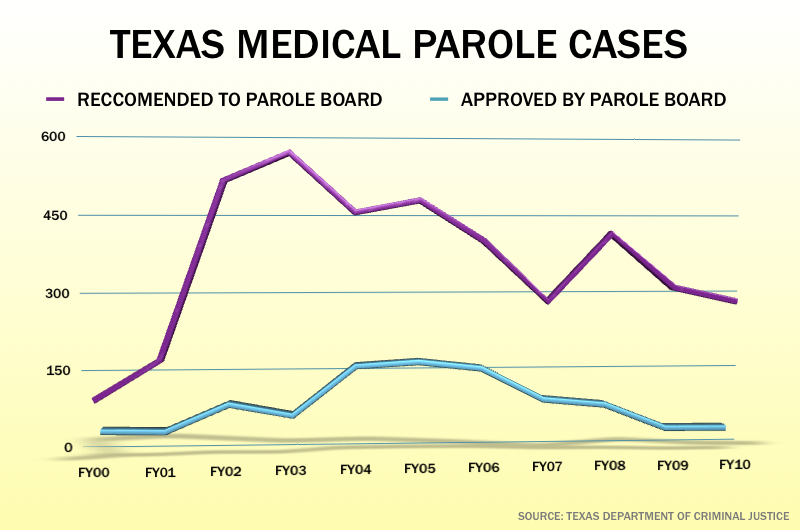
Prison doctors routinely offer up the oldest and sickest of these inmates for medical parole, a way to get those who are too incapacitated to be a public threat and have just months to live out of medical beds that Texas’ quickly aging prison population needs. They’ve recommended parole for 4,000 such inmates within the last decade. But the state parole board, which makes the final decision on “medically recommended intensive supervision,” has only agreed in a quarter of these cases, leaving the others to die in prison — and on the state’s dime.


Texas’ “geriatric” inmates, classified as those 55 and older, make up just 7.3 percent of Texas’ 160,000-offender prison population. But they account for nearly a third of the system’s hospital costs and make three times as many visits to prison medical departments as younger inmates. Elderly inmates have average annual hospitalization costs of $4,700, compared to $765 for inmates under 55. In total, providing inmate medical care costs the state correctional health care system — already facing hundreds of employee layoffs amid a budget shortfall — nearly half a billion dollars a year.


Parole board members say they’re faced with the difficult task of determining whether an inmate is still dangerous and must err on the side of public safety. “You can be sick, have an illness or a disease, and still be a threat,” said board chair Rissie Owens. “Our decisions aren’t based on numbers, on quotas. And we feel like we’re making good decisions.”


But criminal justice and prison funding experts say leaving elderly, terminally ill inmates to waste away behind bars is often unnecessary and exorbitantly expensive. Those costs would be shared with the federal government if the offenders weren’t in state custody.


“These are totally incapacitated inmates, terminally ill inmates, inmates on respirators, who are not paroled at a huge expense to the state and hardship to the inmate’s family because of the nature of a crime they may have committed 20 or 30 years ago,” said Sen. John Whitmire, D-Houston, who chairs the state Senate’s Criminal Justice Committee. “I think it’s largely for political reasons.”


The cost of care


While the total prison population in Texas isn’t growing, it’s quickly aging. The ranks of geriatric inmates are rising by about 6 percent every year, frightening the budget writers who have to figure out how to pay for them. Health care costs are rising too: The average daily medical bill for Texas inmates grows about 4 percent every year — which is low, compared to some states.


The sickest inmates can each cost the state up to $1 million a year in health care costs. If these same inmates were living in nursing homes or hospice facilities, the federal government — through Medicaid — would pay two-thirds of the cost and save Texas taxpayers up to $50 million a year, according to state projections. If the offenders are eligible for Medicare, the feds would pick up the full tab. “We could be transitioning them to some other facility where state taxpayers wouldn’t have to bear the full health care cost,” said Marc Levin, the director of the Texas Public Policy Foundation’s Center For Effective Justice Director, who suggested special nursing homes or hospice centers monitored by parole officers. “It’s a real opportunity to identify some savings without doing anything to endanger public safety.”


But despite the fact that the national one-year recidivism rate for older offenders is miniscule compared to that of younger offenders — 3.2 percent for inmates over 55, compared to 45 percent for inmates between 18 and 29 — an April report by the VERA Institute of Justice, a nonprofit criminal justice policy group, found that the 15 states that allow medical release rarely use it. What stands in the way? Political repercussions, complicated review processes and limited eligibility, the researchers found.


Getting Texas inmates released on medical parole is no easy task. To be eligible for it, an offender can’t be on death row or be serving life without parole, and must be either terminally ill (six months or less to live) or require intensive long-term care, said Dee Wilson, director of the Texas Correctional Office on Offenders with Medical or Mental Impairments. Sex offenders must effectively be in a vegetative state for consideration.


If inmates qualify, the office, in conjunction with the Correctional Managed Health Care Committee, recommends them for medical parole, then submits them to the seven-member Board of Pardons and Paroles for a decision. “It’s all about how long you have to live, and what your prognosis is,” Wilson said. “You can have a terminal illness but still be fully functioning.”


Dying behind bars


The parole board, in turn, relies on a pre-existing condition threshold of sorts. If an inmate with a particular illness commits a crime, Owens said, it’s unlikely he or she will get medical release for that same diagnosis. Some inmates with multiple amputated limbs may look incapacitated, Owens said, but managed to commit their crimes that way. Of the roughly 4,000 inmates prison health officials recommended for medical release in the last decade, the parole board turned down nearly 3,000.


In the last fiscal year alone, more than 440 Texas inmates died in prison. Thirty-one inmates who’d been recommended by medical staff for release died while awaiting the parole board to take up their case; another 26 died after the parole board rejected them for release. Twelve inmates were approved for medical parole but died before they could be sent home.


“There are documented cases where individuals had days or weeks left to live” and were rejected for medical parole, Whitmire said. “I saw no reason why they shouldn’t be paroled so the family could make plans for their funeral.”


Texas is not the only state struggling with skyrocketing prison health care costs and concerns around medical release. Between 1999 and 2007, the number of inmates 55 or older in state and federal prisons grew by more than 75 percent, to 76,000. To date, more than a dozen states have units set aside for elderly inmates; eight have dedicated hospice facilities. Estelle has an impressive medical facility, with a bustling emergency room, high-tech telemedicine equipment and a team of nephrologists that perform 1,800 dialysis treatments a month — sometimes on aggressive or unstable inmates.


“From a medical perspective, I’m comforted that [offenders are] getting a level of care they may not be getting on the street. On the other hand, we’re about to un-employ 363 people,” said Dr. Owen Murray, the chief physician for the University of Texas Medical Branch’s correctional managed care program, which oversees health care for the majority of Texas’ prisoners — and is facing layoffs this summer. “Are there other strategies to reduce our costs? And how do we prevent having to build more expensive units in the future?”


Charles Dill, a 71-year-old offender who started a 20-year sentence in 2000, has been hospitalized multiple times himself for costly heart problems, including getting stents for his carotid arteries. He’s befriended several elderly inmates in Estelle’s geriatric unit, only to watch them die on the ward.


“I’ve seen several of these guys drop over dead,” Dill said, gesturing across a prison dorm room of prosthetic limbs and wheelchairs, adult incontinence products and white-haired men in Coke-bottle glasses. “I guess they completed their sentence.”