The 'Friends of Marcia Powell' are autonomous groups and individuals engaging in prisoner outreach, informal advocacy, and organized protest and direct actions in a sustained campaign to: promote prisoner rights and welfare in America; engage the Arizona public in a creative and thoughtful critique of our system of "justice;” deconstruct the prison industrial complex; and dismantle this racist, classist patriarchy...

Retiring "Free Marcia Powell"

As of December 2, 2010 (with occasional exceptions) I'm retiring this blog to direct more of my time and energy into prisoner rights and my other blogs; I just can't do anyone justice when spread so thin. I'll keep the site open so folks can search the archives and use the links, but won't be updating it with new posts. If you're looking for the latest, try Arizona Prison Watch. Most of the pieces posted here were cross-posted to one or both of those sites already.

Thanks for visiting. Peace out - Peg.
Showing posts with label political prisoners. Show all posts

Sunday, July 3, 2011

To Be Free: Nina, Marilyn, and Perryville Women's Resistance.


One of the best professors I've ever had, documentary producer HLT Quan, turned me on to Nina Simone during my course with her on Social Movements at Arizona State University a few years ago. Dr. Quan probably doesn't realize it, but she has a lot to do with me embracing prison abolition. I ended up dropping out of school to take all this on, in fact...

Anyway, this tune is to honor the women of Arizona's Perryville prison in Goodyear who have been resisting coercion and abuse of late, and fighting back by speaking out. That not only goes for those prisoners assigned to the Martori Farms work crew, but those who are contesting the poor medical care, writing letters to legislators about conditions, helping other women file grievances, and resisting in a host of other ways - some much more subtle, like teaching another woman to read.

Now, the prisoners can't watch this video, but imagine that just for a few minutes you can commandeer a guard station and the prison communications system. Lock yourselves in, pop open all the cells, crank out a soulful tune, and dance...that would almost be worth the price one would undoubtedly have to pay, once they broke in and took you down for it.

That's just a fantasy to enjoy, women, not advice.

I often play Nina in remembrance of poet and former political prisoner Marilyn Buck - known as "the only white member of the Black Revolutionary Army".
She was sentenced to 80 years for armed car robberies she carried out to fund liberation movements, as well as for the 1979 escape of Assata Shakur from a New Jersey prison. Marilyn and her comrades (see the Resistance Conspiracy) were also prosecuted for the 1983 bombing of the U.S. Senate building.

During her incarceration, Marilyn was known for her continued outspoken criticism of the US government and the prison industrial complex and her advocacy on behalf of other prisoners in addition to her art and poetry. Branded as one of the most infamous women "ter
rorists" of the 20th century, even after 15 years in federal custody Marilyn was considered such a threat that she was thrown into the hole and forbidden to even contact her attorney for two weeks after the attacks of 911, while they investigated any possible connection she had to them.

Because of that - and the officer and guards killed in the Brinks robberies - I never would have expected the feds to release her on parole. Never. What a blessing that they did. Marilyn developed an extremely aggressive cancer and was paroled on compassionate grounds last summer, two weeks before she died. She was always more free, however - even in prison - than most Americans who go through their lives as sheep.

Take some time to check out Marilyn's work
...start with the Wild Poppies CD at Freedom Archives. Here's the title piece...


Wild Poppies

Marilyn Buck

[This poem is read on the CD by Marilyn Buck. MP3 of this poem]


I remember red poppies, wild behind the school house
I didn’t want to be there, but I loved to watch the poppies

I used to sit in the window of my room, sketching charcoal trees
what happened to those magnolia trees, to that girl?

I went off to college, escaped my father’s thunderstorms
Berkeley. Rebellion. Exhilaration!

the Vietnam war, Black Power, Che took me to Chicago
midnight lights under Wacker Dr. Uptown. South Side. Slapped
by self-determination for taking Freedom Wall photos
without asking

on to California, driving at 3:00 in the morning in the mountains,
I got it: what self-determination means
A daunting task for a young white woman, I was humbled

practice is concrete … harder than crystal-dream concepts

San Francisco, on the front steps at Fulton St.
smoking reefer, drinking “bitterdog” with Black Panthers and white
hippie radicals, talking about when the revolution comes

the revolution did not come. Fred Bennett was missing
we learned he’d been found: ashes, bones, a wedding ring
but later there was Assata’s freedom smile

then I was captured, locked into a cell of sewer water
spirit deflated. I survived, carried on, glad to be
like a weed, a wild red poppy,
rooted in life


And this was one of Marilyn's last published essays, printed by Critical Resistance's paper, "The Abolitionist" (W2010):


Alternatives While Waiting: Self-Reliance
by Marilyn Buck


A community’s people, with their creative energy and labour, are the greatest resource it has, but an increasing number, mostly young, are MIA, in graves or prisons, into which so many rush obliviously when they act out Hollywood-constructed desires, images, and stereotypes to “make it” in the midst of still-white supremacist and hierarchical America. Far too many have embraced the 30 years of culturally-contrived amnesia that has mis-educated them to believe in the very system that exiles them to the cages. Valuable human beings – community residents, who could have and should have been the teachers, nurses, doctors, mechanics, public servants, and builders of their communities are disappeared.

Among the disappeared and exiled, many haven’t been formally educated or taught to read well, having dropped out or been driven out of the faltering California school systems, weakened both by funding and a general disregard for and animosity towards the children of the working and underemployed classes, particularly when Black, Latino, or Asian. There are a few, if any, educational or rehabilitation-geared programs within prisons. On a recent KPFA radio program, a freed elder pointed out that many of California’s prisons are on lock-down at any given time, meaning that the few programs that do exist, however reluctantly and apathetically, do not function much of the time.

In the prison charnel houses, forgetfulness or oblivion settles like quicklime on the spirit, intelligence and bodies of exiled and illegalized young people. A sense of responsibility to the community is replaced with rage, and beneath any posturing, despair, self-mutilation, and suicide.

Alternatives? To re-imagine communities with the resources to educate children, to provide work with sufficient income, to get drugs and the weapons of collective suicide out, to make the streets safe again for children, elders and the young women and men. This is similar to the 10-point program the old Black Panther Party called for, a program that in slightly different manifestations is still understood world-wide as necessary for community and nations’ health and well-being for peace and justice.

It’s never too later to learn, to get educated or develop the social or political conscience necessary to challenge the systematic social genocide of our communities. No one has to stay lost; no one is not subject to change. The question is: will you change yourself, have a hand in your destiny and development, or will you accept the changes forced at you by the prison systems’ dog-eat-dog programming that wants you to become a gladiator and a puppet?

There are many who are looking for ways to break such a decimating cycle. Meanwhile, what? The prisoner’s alternative is not to wait for alternatives and social change from the outside, but to begin a process of reconstruction on the inside.

To be a builder, or to be a demolisher, those are the choices. It’s easy to demolish, to destroy. You can be a one-man or a 100-man wrecking crew, but to build you have to become a bricklayer, willing to dig foundations, willing to take care of your neighbourhood and work with others. It means being humble and giving back because when you left you took a whole lot of human and community potential with you. It means learning what you need to know. Find a teacher, no matter whether they wear your colours, are your colour, or are low on the ladder of that peculiar prison concept of “respect.” (Prison culture doesn’t really give any prisoner true respect, or better-said, dignity; the man is still pulling the strings.) If you can’t earn a skill you want where you are (like being a doctor or an environmental engineer), learn all you can about the world. Learn about other societies; learn about communities’ fight for self-reliance and self-determination. Learn Spanish, or English, or Chinese. Or history. The more you study about the world, the better able you will be to see where you are and can go in the world. Choose to be on the side of the people who are not the greedy rulers and bosses.

Of course it’s easier to succumb to the haters who want to decimate your community, and to hang with those who participate in the suicide of their own communities through ignorance and individualism. Reignite your creativity and imagination that you may have put aside when you were 14 or that was discouraged in school. There is enough war from without, end the wars from within. Nothing can be build during a civil war, and certainly nothing can be defended from the war from without, without skills, knowledge and dignity of connection to and love for your community. Become a warrior for reconstruction.

Set a premium on education. No one can ever take it from you. Ultimately, knowledge and skills are more valuable than gold and SUVs, or anything you may have possessed for a few brief moments in life, before prison became your home with its prolonged lesson in absence.

Thursday, February 3, 2011

Charges dismissed against the Arpaio 5.

Been battling dental oppression lately which derailed me early into Garyn and Claire's trial today, so I missed the grand finale, personally, and haven't seen much of a write up yet from others. As court was getting underway this AM - the prosecution having rested yesterday on the conflicting testimony of several cops - the defense was busy working on photographs and videos they had to submit into evidence. (If you ever need that for your own trial, bring a back-up machine - they don't have prompt service if their own projector or other equipment fails). The judge heard "Rule 20" motions from both defense attorneys. Rule 20 states the following:

Rule 20. Judgment of Acquittal

a. Before Verdict. On motion of a defendant or on its own initiative, the court shall enter a judgment of acquittal of one or more offenses charged in an indictment, information or complaint after the evidence on either side is closed, if there is no substantial evidence to warrant a conviction. In an aggravation hearing, after the evidence on either side is closed, on a motion of a defendant or on its own initiative, the court shall enter a judgment that an aggravating circumstance was not proven if there is no substantial evidence to warrant the allegation. The court's decision on a defendant's motion shall not be reserved, but shall be made with all possible speed.

b. After Verdict. A motion for judgment of acquittal made before verdict may be renewed by a defendant within 10 days after the verdict was returned.


The defense put up their first witness, a photographer who was present at the rally on January 16, 2010. They adjourned for lunch to research a few things, then reconvened and the judge dismissed charges due to lack of evidence that the state could obtain a conviction on any count if they proceeded. In other words, we ended up with a fair and honest judge, this time, and the cops who could have so easily compared their stories and lied to make for a better case, didn't. Maybe they were all satisfied with the jail time they nailed Grace with in her plea bargain.

I had to leave before lunch, but it's my understanding that the charges are all dismissed with prejudice, meaning that the state can't turn around and charge Claire or Garyn again. YAY!!! Way to hang in there, you two.

I learned a lot from the cops about riot control procedures during this trial, and about their own vulnerabilities when it comes to making arrests that can actually be prosecuted. The cops couldn't even identify each other in the march, much less individual protestors. They were disoriented and confused when the pepper spray hit, even the ones in gas maks. Their testimony was conflicting, except that all indicated pepper spray was deployed, it was a chaotic atmosphere, it was hard to hear and see, and no one identified themselves as police to Garyn or Claire until after they were in custody.

Garyn was arrested on the word and gesture of a cop whose glimpse of a similarly-dressed bottle-thrower was immediately obscured by pepper spray; an officer who couldn't even identify him as the thrower in the aftermath. He was handed off to several other officers for detention, arrest, and booking, such that it sounds as if the booking officer never even heard the integrity of the direct testimony of the witness. That was how the cops were organized out there to function, too - the front line would hand suspects out to the arrest team with a brief synopsis of what happened, then fall back in line, not follow through with the booking themselves - not really even know who was doing it, apparently.

The myth that made Claire an accomplice to Garyn's non-act of resisting arrest - supposedly chaining herself by the neck to his body in an attempt to obstruct police - was repeated by every cop that testified about her yesterday, but no one had any evidence of such a chain or leash, no did any of them see Claire wearing anything resembling a collar. The only possible explanation for this phenomena seems to be that Claire's purse strap got caught on Garyn somehow and when the police tried to take him town, they dragged her down on top of him, kicking and screaming with no idea of what was happening. It's a wonder no one got seriously hurt.

It was also clear from police testimony that they were expecting "trouble" from the anarchists by the time the marchers reached the site where the pepper spray was deployed - it sounds like they were trying to provoke it along the route. I saw photos and heard testimony myself that cops were punching people in the black bloc crowd before any bottles were thrown.

That all said, I think Stephen Lemons and the Phoenix New Times owe the Arpaio 5 a big apology for convicting them before trial last year, and not showing up to see how the real thing turned out.

Sunday, September 12, 2010

All my friends have FBI files: Policing prisoner support networks.

This "heads up" to prisoner support networks came today by way of the Freedom Archives' Political Prisoner Newsletter. I lost track of all the watch lists my friends and I should be on by now, but this might be an added motive behind anyone feeling particularly surveilled, harassed, or abusively prosecuted. Apparently if the feds really have it in for the prisoner we correspond with (like Marilyn Buck, whom one likely cop left me a disturbing comment about recently) - they'll just send the local and state police after us, wherever we may be in the world.

It all smacks of COINTELPRO and is probably legitimized under the Patriot Act.
Ironic that anyone would be so worried about our kind of "extremists" in this state - it's the ones holding office who really threaten public safety, not the Anarchists.

I shouldn't really have to say this, but no matter how "innocent" you think are, don't let anyone in uninvited without a proper warrant. And check out the link below to request your FBI file; I bet you have have one, if you've read this blog more than once.


---------------------------------


From: sacprisonersupport@riseup.net
Date: Sun, September 12, 2010 4:16 am

Recently we began receiving documents in response to a FOIA request we filed with the FBI about Eric McDavid. The documents have uncovered a few alarming pieces of information, but one in particular we felt it necessary to share with the public as soon as possible. For years people have been speculating that writing political prisoners would result in a person being “put on a list.” Unfortunately, it seems that those speculations were not unfounded.

We have received perhaps hundreds of pages documenting Eric's correspondence with other people. These letters are not just kept on file ­ the Sacramento County Main Jail forwarded all of these letters to the Sacramento FBI field office, which then forwarded them to local field offices around the country (and to law enforcement internationally) to warn the FBI in other cities of a “possible environmental/ animal rights extremist” or “a possible anarchist extremist” in their community.

Originally, the FBI's communications included a statement that “Sacramento is forwarding this communication for information purposes only.” But later, they began including a much longer statement which read, in part: “this information has been determined to be of such a nature that some follow-up as to the possibility of criminal activity is warranted...” These statements were included no matter what was the content of the letter ­ often the documents include the statement that the letter was “benign in nature.”

It is unclear whether or not the FBI is still forwarding Eric's correspondence to local field offices. We have not received any documents dated after his move to a federal facility. It is also unknown whether or not all correspondence with political prisoners is treated in the same
manner. What we do know is that if a person sent Eric a letter to the Sacramento County Main Jail with their full name and address on it, the local FBI field office more than likely now has that information.

We are not sharing this information to raise alarm or spread fear. We have every intention of continuing to write political prisoners, and we urge others to do the same. That said, we hope to expose the FBI's politically motivated investigations and, unlike the FBI, we believe people have a right to know when they have been spied on. This kind of government intrusion could cause the “chilling effect” so often thrown about in conversations about 1st amendment activities. But when we give in to those fears, political prisoners are the ones who suffer. And this is exactly what the government wants.

The state is constantly trying to expand its reach by gathering information about social movements and those who participate in them. Instead of letting this new information scare us
into silence, we should use it to make informed decisions about how we support and prioritize political prisoners. This kind of repression has implications for more than just people involved in “activism.” Millions of people are incarcerated in this country. It is possible that the government uses similar tactics to investigate other communities that they actively repress. Writing our friends, family members and comrades should not be a justified excuse for investigation ­ no matter who our friends are.

If you would like to view some of these documents, you may do so at:
http://www.indybay.org/newsitems/2010/09/12/18658489.php

If you would like to find out if the FBI has been collecting information on you, here is a website that explains how to request information underthe freedom of information act.

http://www.firstamendmentcenter.org/press/information/topic.aspx?topic=how_to_FOIA


Freedom Archives
522 Valencia Street
San Francisco, CA 94110

415 863-9977

www.Freedomarchives.org


Questions and comments may be sent to claude@freedomarchives.org

Thursday, July 15, 2010

US Political Prisoners "Stay Strong".

News on our other political prisoners this week is not as good at that which we just received on Marilyn Buck...

----------------------

Ashanti Alston shared the following note from former Black Panther Sundiata Acoli, who was recently in front of the parole board:

July 14, 2010

Greetings All,

Received a letter today from the Board advising that the 3-Member Panel gave me a 10 year "hit." The basis for the hit will be explained in the Notice of Decision which will be forwarded to me upon its completion. I'll forward copies of the Decision to the Attys and SAFC when I receive it. Stay strong, I will too.

L, S, Su


-----------------------------------

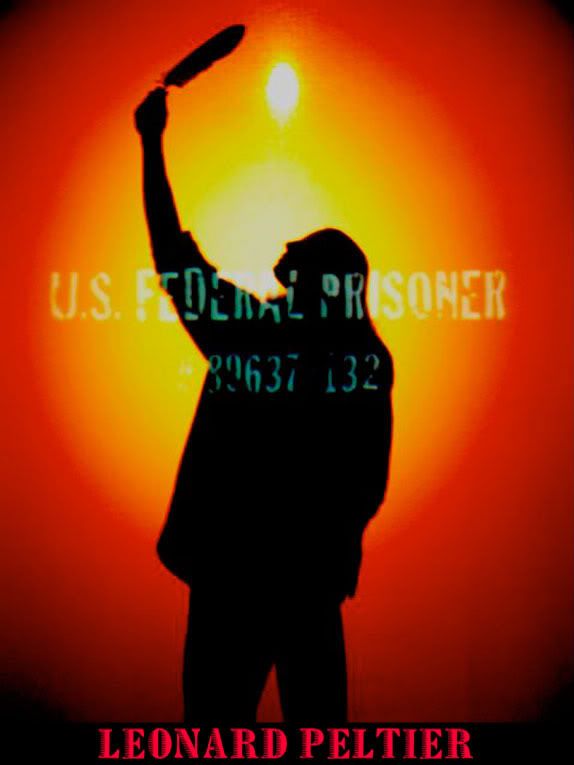
A contract has reportedly been put out on Leonard Peltier's life. He's presently at Lewisburg federal prison. Don't bother with the warden there - contact the White House to demand extra protection for him (202-456-1111). Tell them its long past time to set that man free, while you're at it.

-------------------------


Long time liberation movement lawyer Lynne Stewart was handed a ten year sentence this week because the government had appealed her original sentence of 28 months, arguing it was too short (they wanted her to die in prison). This one may turn out to be a death penalty, as at the age of 70 she's fighting cancer behind bars, where the odds aren't so good, so send healing thoughts her way. Lynne's supporters' website, above, should have updated info on where/how to send her words of encouragement and solidarity. Keep her engaged in the movement without getting her into trouble*, if you can.


* I probably shouldn't have to say this, but all political prisoners' incoming and outgoing mail is read, logged, and censored as the government sees fit for these folks, so keep in mind that if you write to any of them you'll end up on a list of people who correspond with "terrorists"- and if you send anything too inflammatory they might have to pay for it, not you, so be cool. *


I recently made up a bunch of protest postcards, by the way, which can be good to send to prisoners if they're allowed to get the DIY kind. You can make them out of your own protest photos, like this one from a First Amendment rights event we chalked outside of (color computer-enhanced):


or something about current events like this:


Make sure to keep the activities you photograph legal, please. For the one on the left I didn't litter or commit criminal damage, I'm just holding my banner there, and was able to bring it home and re-use it elsewhere. I actually made a lot of postcards for local politicians and national media out of that one to show that the Resistance here is alive and well.


If you have the computer and printer but not a camera, then you might download or scan cool images like this one, which honors all political prisoners (quote by Elizabeth Gurley-Flynn):

The art is by Ricardo Levins Morales from the now-disbanded Northland Poster Collective. Morales has great stuff and would probably be honored if something like this was mailed to political prisoners -just give credit where it's due and don't mass-produce. Buy his posters and notecards there if you can - he's got some amazing work - it's all social justice stuff. Check it out.


So, those are just a few ideas. You can fit four postcards on a piece of 8 1/2 x 11 card stock or cheap photo paper, and even design the other side like a regular postcard, with captions and stuff. Prisoners of all stripes tend to get a kick out of them - especially if you've done some creative direct actions. I've also made signs to hold up and shoot for specific prisoners and done more stuff like that chalking up there (that's not the best, but she liked it. At least it gives you the idea). Once you get the technicalities worked out of setting up the postcard page, it's pretty easy to keep making them for people - assuming you've got the computer and printer handy.

All three names up there are linked to their websites, which almost always have prisoner contact info. I have a whole bunch of political prisoner links on the Prison Abolitionist, too, near the end of the left column. If you're think of writing to an activist slammed hard in the Green Scare (Jeffrey Leurs is free, now, by the way), or perhaps to a lesser-known prisoner, there are far too many to choose from.

Whether or not the prisoner you correspond with has a website put up by supporters (if they don't that's a clue that they might not be getting a whole lot of mail, so you might want to reach out to them), once you figure out what prison system they're in (most but not all are in federal prisons), check out the appropriate website to make sure you know the mail policies (here's the BOP's). That'll save a little hassle and time.

Another good resource for political prisoner contact info is the zine produced by Jaan Lamaan and friends, 4struggle mag. In fact, if you hunt around you'll find a few publications with letters from prisoners of all kinds in them who are interested in corresponding.

Finally, if you're doing more than just a one-time salute, make sure it's something you can stick with and that your priority is to support the prisoner, not to get your own ego needs met. Just because you can't see or speak to them face-to-face doesn't mean that you don't end up developing a relationship that your pen-pal may find a welcome relief from the misery of incarceration. As in any friendship, honor them by remaining engaged and responsive, or don't set them up only to fall silent to begin with. Try to be consistent. Try not to be too intrusive, and don't talk about their politics - let them do that if they want to. They know better than us what's safe ground to cover and what's taboo.

I say that all from experience, unfortunately - I've learned too much at others' expense at times, I'm afraid. Hopefully you won't repeat the same mistakes I've made.

Good luck.

Saturday, June 5, 2010

Distress: Remembering Marcia Powell.

"Distress", made by Marritte Funches, 2010. In remembrance of Marcia Powell, who died a year ago when Arizona prison guards left her unattended all day in a cage in the desert sun.

He also reminds us of some of the living: political prisoners currently imprisoned or in exile. Please give special thought, as well, to Marilyn Buck, now fighting cancer at the BOP's Federal Medical Center (FMC) Carswell, in Texas.

Thursday, April 8, 2010

Support the Eco-Prisoners (April 2010)

I have been remiss about updating this list in the margins, so here's the latest...

From the Break the Chains blog, an excellent resource re: North American Political Prisoners. Their list appears to be from the Earth Liberation Prisoner Support Network (based in the UK and also a great resource).

--------------------
Spirit of Freedom
(April 2010)
Produced by
EARTH LIBERATION PRISONERS SUPPORT NETWORK

"The whole experience has been tough, but all the kind and strengthening words and
wise thoughts from strangers made it much easier!" (Former Swedish Animal Rights
Prisoner)

Welcome to the April 2010 edition of Spirit of Freedom. As we go to print we are
awaiting the sentencing of American eco- activist Steve Murphy who has admitted
conspiracy to commit arson following an attempted arson on a town house which was
claimed by the ELF. Steve is expected to be sentenced very soon and we will send
out the details of his sentence as soon as we have them.

Other major news is that British Animal Rights activist, Mel Broughton was recently
released from prison on Bail! In December 2007 Mel was remanded accused of activity
related to Oxford University (Mel is a well known campaigner against animal abuse
carried out by the University). In Feb 2009 he was sentenced to 10 years
imprisonment because of his campaigning. However last month the Court of Appeal
quashed his charges and he was released on Bail. However he is now expected to face
a new trial in June 2010. ELP will follow this trial and bring you news as we get
it.

The news of Mel’s release is brilliant. But please do not forget the other
prisoners who remain locked up away from their friends and loved ones. All of the
prisoners listed below welcome letters of support. So please, regardless of what
languages you speak and regardless of where you live in the world, please support
the eco-prisoners and no compromise in defence of Mother Earth!

If anyone notices any of ELP's prisoner details is out of date or we do not list a
prisoner who we should list, please let ELP know as soon as possible. ELP is run by
a small group of volunteers and although we try to ensure our lists are accurate, we
admit we do make mistakes. So help us help keep the lists accurate by letting us
know of any changes we need to make.

ECO-DEFENCE PRISONERS

Grant Barnes #137563, San Carlos Correctional Facility, PO Box 3, Pueblo, CO 81002,
USA. Serving 12 years for setting fire to a number of SUV vehicles. The letters ELF
were spray painted onto all of the vehicles. (Grant is a vegan).

Nathan Block, #36359-086, FCI Lompoc, Federal Correctional Institution, 3600 Guard
Road, Lompoc, CA 93436, USA. Serving 7 years & 8 months for an ELF arson against a
Poplar Tree Farm and an ELF arson against an SUV dealership. Also admitted his role
in an ELF/ALF conspiracy. (Diet unknown).

Marco Camenisch, Postfach 3143, CH-8105 Regensdorf, Switzerland. Serving 18 years.
1) Ten years for using explosives to destroy electricity pylons leading from nuclear
power stations. 2) Eight years for the murder of a Swiss Boarder Guard whilst on the
run. In '02 Marco completed a 12-year sentence in Italy for destroying electricity
pylons in Italy. (Marco is a meat eater who encourages organic living).
Leonardo Landi, Carcere San Michele, Via Casale, 50/A, 15122 San Michele (AL),
Italy. Il Silvestre activist awaiting trial accused of robbery.
(Leonardo is a vegetarian).

Marie Jeanette Mason, #04672-061, FCI Waseca, Federal Correctional Institution, PO
Box 1731, Waseca, MN 56093, USA. Serving 21 years and 10 months for her involvement
in an ELF arson against a University Professors Office as the Professor was linked
to Genetically Modified crop testing. Marie also admitted destroying logging
equipment. She also pleaded guilty to conspiring to carry out ELF actions and
admitted involvement in 11 other ELF actions and 1 ALF action. (Marie is a vegan).

Abraham López Martínez (Jailed in Mexico). E-mail letters of support to
cna.mex@gmail.com On remand accused of a series of ELF style activities against
various trucks and businesses. (Abraham is a vegan)

Eric McDavid, 16209-097, FCI Victorville, Medium II, Federal Correctional
Institution, PO Box 5300, Adelanto, CA 92301, USA. Serving 19 years & 7 months for
planning to destroy the property of the U.S. Forestry Service, mobile phone masts
and power plants. At the point of his arrest no criminal
damage has actually occurred. (Eric is a vegan).

Daniel McGowan, 63794-053, USP Marion, US Penitentiary, PO Box 1000, Marion, IL
62959, USA. Serving 7 years for an ELF arson against a Poplar Tree Farm and an ELF
arson against an old growth logging corporation. Also admitted his role in an
ELF/ALF conspiracy. (Daniel is a vegetarian).

Steve Murphy 0910300841, Central Detention Center, 630 East Rialto Ave, San
Bernardino, CA 92408, USA. Awaiting sentencing after admitting Conspiracy to Commit
Arson following an attempted arson at a town house construction site in 2006. The
action was claimed under the banner of the ELF. (Steve is a vegan).

Jonathan Paul - See details in Animal Liberation Prisoners List.

Justin Solondz (Address Unknown - China). American Green Scare defendant accused of
direct action activity in America. Serving 3 years in China for drugs related
offences then due to be deported back to America. His exact prison location is
currently unknown. (Diet unknown).

Jonatan Strandberg, KVA Hällby, Box 100, 64045 Kvicksund, Sweden. Serving 15 months
imprisonment after admitting damaging a communication tower used by the Department
of Defence, cutting the cables on a crane used in creating urban sprawl, and
damaging a vehicle used in the logging industry. (Jonatan is a meat eater).

Michael Sykes 696693, Michigan Reformatory, 1342 West Main Street, Ionia, MI 48846,
USA. Serving four to ten years for anti-sprawl arsons, criminal damage to a utility
pole, spray-painting political graffiti and burning the American flag. (Diet
unknown)

Fermín Gómez Trejo (Jailed in Mexico). E-mail letters of support to
cna.mex@gmail.com On remand accused of a series of ELF style activities against
various trucks and businesses. (Fermin is a vegetarian)

Briana Waters 36432-086, FCI Danbury, Federal Correctional Institution, Route 37,
Danbury, CT 06811, USA. Serving six years for involvement in an ELF arson on a
University. (Diet unknown).

Joyanna Zacher, #36360-086, FCI Dublin, 5700 8th St.- Camp Parks- Unit F, Dublin, CA
94568, USA. Serving 7 years & 8 months for an ELF arson against a Poplar Tree Farm
and an ELF arson against an SUV dealership. Also admitted her role in an ELF/ALF
conspiracy. (Diet unknown).

ANIMAL LIBERATION PRISONERS
(All Animal Liberation Prisoners follow a minimum vegetarian diet and most are vegan).

Jonny Ablewhite TB4885, H.M. Prison, Hewell Lane, Redditch, Worcs B97 6QS, England.
Serving 12 years for attempting to blackmail a farmer who supplied guinea pigs for
vivisection. (Jon is a vegan).

Dan Amos A6987AN, HMP Guys Marsh, Shaftesbury, Dorset, SP7 0AH, England. Serving 4
years for conspiracy to blackmail Huntingdon Life Sciences. (Dan is a vegan)

Gregg Avery TA7450, HMP Coldingley, Shaftesbury Road, Bisley, Woking, Surrey GU24
9EX, England. Serving 9 years for conspiracy to blackmail Huntingdon Life Sciences.
(Gregg is a vegan).

Natasha Avery NR8987, HMP Send, Ripley Road, Woking, Surrey, GU23 7LJ, England.
Serving 9 years for conspiracy to blackmail Huntingdon Life Sciences. (Nat is a
vegan).

Alex Hall, Inmate #2009-06304, Davis County Jail, 800 West State St., Farmington, UT
84025, USA. On Remand accused of raiding a mink farm. Also accused of breaching bail
conditions whilst on bail. (William is a vegan).

Kevin Kjonaas #93502-011, FCI Sandstone, PO Box 1000, Sandstone, MN 55072 USA.
Serving 72 months imprisonment for helping organise the SHAC-USA campaign. (Kevin is
a vegan).

Marie Mason - See details in Eco Defence Prisoners List.
Daniel McGowan - See details in Eco Defence Prisoners List.

Gavin Medd-Hall WV9475, HMP Coldingley, Shaftesbury Road, Bisley, Woking, Surrey
GU24 9EX, England. Serving 8 years for conspiracy to blackmail Huntingdon Life
Sciences. (Gavin is a vegan).

Heather Nicholson A3158AJ, HMP Foston Hall, Foston, Derby, Derbyshire, DE65 5DN,
England. Serving 11 years for conspiracy to blackmail Huntingdon Life Sciences.
(Heather is a vegan).

Kevin Olliff, #1300931, TTCF 161 D-Pod, 450 Bauchet St., Los Angeles, CA 90012, USA.
On remand accused of stalking as well as conspiracy and criminal threats towards
UCLA vivisectors and a company linked to vivisection. (Kevin is a vegan).

Jonathan Paul, #07167-085, FCI Phoenix, Federal Correctional Institution, 37910 N
45th Ave., Phoenix, AZ 85086, USA. Sentenced to 51 months for an ALF arson on a
horse meat plant. Also admitted his role in an ELF/ALF conspiracy. (Jonathan is a
vegan).

Lewis Pogson A6454AK, HMP Lincoln, 106 Greetwell Road, Lincoln, LN2 4BD, England.
Serving 3 years for rescuing 129 rabbits from Highgate Farm. (Lewis is a vegan).

Sergio Stefani - See Other Political Prisoner List.

William James Viehl, Inmate #15909-081, FCI Terminal Island, Po Box 3007, San Pedro,
CA 90731, USA. Serving two years for his role in an ALF raid on a mink fur farm.
(William is a vegan).

Nicole Vosper VM9385, HMP Bronzefield, Woodhthorpe Road, Ashford, Middx, TW15 3JZ,
England. On remand accused of blackmailing Huntingdon Life Sciences. (Nicole is a
vegan).

Dan Wadham, A5705AA, HMP Camp Hill, Newport, Isle of Wight, PO30 5PB, England.
Serving 5 years for conspiracy to blackmail Huntingdon Life Sciences. (Dan is a
vegan).

Kerry Whitburn TB4886, HMP Lowdham Grange, Lowdham, Nottingham, NG14 7DA, England.
Serving 12 years for attempting to blackmail a farmer who supplied guinea pigs for
vivisection. (Kerry is a vegan).

Sarah Whitehead, VM7684, HMP Bronzefield, Woodthorpe Road, Ashford, Middx, TW15 3JZ,
England. Serving two years for: 1) rescuing a puppy from horrific conditions. 2)
rescuing over 100 animals from a pet breeder who was later prosecuted for animal
abuse. Also awaiting trial for SHAC activity. (Sarah is a vegan)

PLOUGHSHARES PRISONERS

Helen Woodson, 03231-045, FMC Carswell - Admin. Max. Unit, POB 27137, Ft. Worth, TX
76127, USA. Serving 8 years 10 months for actions that focused on the
interrelationship of war & the destruction of the natural world. The actions
included pouring red paint over the security desk of a federal court and making
threatening communications. Previously Helen had served 20½ years for: 1) Using a
hammer to disarm a nuclear missile silo. 2) Burning $25,000 on the floor of a bank
whilst denouncing war, environmental destruction & economic injustice. 3) Mailing
warning letters with bullets attached to Government & corporate officials. (Diet
unknown).

OTHER ANTI-WAR PRISONERS

Elija Smith VP 7551 HMP Lewes, 1 Brighton Rd, Lewes, Sussex, BN7 1EA, England. On
remand accused of disarming a weapons factory, which, amongst other things, makes
Hellfire Missiles. The action was in protest at Israel military action against Gaza.
(Diet unknown).

ANTIFA PRISONERS

Aleksey Bychin, FBU OIK-2 IK-7 otryad No. 7, ul. Karnallitovaya d. 98, g. Solikamsk
Permskiy Kray, 618545 Russia. Serving 5 years for defending himself against
neo-nazis. (Diet unknown).
Andrei Mergenov, FGU IZ 64/1 OKB 2 komn. 73, Up. Kutyakova 107, 410601 Saratov,
Russia. Serving 3 years for fighting with neo-nazis. (Diet unknown)

OTHER PRISONERS

Pavel Delidon, ul. Timiryazeva-1, FGU IK-7, 309990 Valuyki Russia. Anarchist/Animal
Rights activist jailed for attempting to obtain wages owed to him, but which had not
been paid to him by his employer. IMPORTANT: Pavel can only receive letters written
in Russian. He is punished by the prison
if he receives a letter not written in Russian so please, only send letters written
in Russian. (Diet unknown).

Alessandro Settepani, Carcere San Michele, Via Casale, 50/A, 15122 San Michele (AL),
Italy. Co-defendant of Sergio Stefani. Arrested for stealing a car and then remanded
for "Subversive Conspiracy" and remanded into a prison for political activists.
(Alessandro is a vegan).

Sergio Maria Stefani, Carcere San Michele, Via Casale, 50/A, 15122 San Michele (AL),
Italy. Former ALF prisoner arrested for stealing a car and then remanded for
"Subversive Conspiracy" and remanded into a prison for political activists. (Sergio
is a vegan).

Fran Thompson, #1090915, CCC, 3151 Litton Drive, Chillicuthe, MO 64601, USA. Serving
Life for killing, in self-defence, a stalker who had broken into her home. Before
her imprisonment Fran was an eco, animal & anti-nuke campaigner. (Fran is a vegan).

MOVE
MOVE is an eco-revolutionary group who carried out protests in defence of all life.
All move prisoners describe themselves as vegetarians. There are currently eight
MOVE activists in prison each serving 100 years after been framed for the murder of
a cop in 1979. 9th defendant, Merle Africa, died in prison in 1998.

Debbie Simms Africa (006307), Janet Holloway Africa (006308) and Janine Philips
Africa (006309) all at: SCI Cambridge Springs, 451 Fullerton Ave, Cambridge Springs,
PA 16403-1238, USA.

Michael Davis Africa (AM4973) and Charles Simms Africa (AM4975) both at SCI
Graterford, PO Box 244, Graterford, PA 19426-0244, USA.

Edward Goodman Africa (AM4974), SCI Mahanoy, 301 Morea Rd, Frackville, PA 17932, USA.

William Philips Africa (AM4984) and Delbert Orr Africa (AM4985) both at SCI Dallas
Drawer K, Dallas, PA 18612, USA.

Mumia Abu Jamal, (AM8335), SCI Greene, 175 Progress Drive, Waynesburg PA 15370, USA.
In 1981 Mumia, former Black Panther and vocal supporter of MOVE, was framed for the
murder of a cop. He was originally sentenced to death but is currently awaiting
re-sentencing following a court hearing in
2001.

STATEMENT ON VIOLENCE
Some people listed in this newsletter have carried out violent actions including
assault and murder. 'Spirit of Freedom' does not condone violence. But we are also
against censorship & believe people can decide
for themselves who they wish to support.

ABOUT E.L.P. SUPPORT NETWORK
ELP is an international eco-prisoner support network founded, in Britain, in 1993 to
support jailed eco-activists. We support the prisoners by producing various regular
prisoner lists:

Spirit of Freedom is ELP's international monthly prisoner listing which is
circulated by e-mail.

Urgent ELP! Bulletin is an e-mail service that distributes the names of any new
eco-prisoner as soon as ELP gets their details. For more info e-mail
ELP4321@hotmail.com

On-Line Newsletters - ELP has a number of websites that provide news, prisoner lists
and additional info about ELP & the prisoners.

English language ELP Website
www.spiritoffreedom.org.uk

Greek language ELP Website
http://greekelp.blogspot.com

North American ELP Website
www.ecoprisoners.org

Turkish language ELP Website
www.geocities.com/yesilanarsi/elp.htm

ELP Extra is an e-mail group that circulates the details of political prisoners, ELP
learns about, who do not fall within the remit for support by ELP. To subscribe to
the list e-mail ELP4321@Hotmail.com

Australian ELP.SN is our Australian contact. For more info e-mail elp4321@hotmail.com

Belgium ELP.SN is our Belgium contact. For more info e-mail elp_bel@hotmail.com

German ELP.SN is a prisoner led initiative run by eco-prisoner Marco Camenisch. For
more info contact Marco Camenisch, Postfach 3143, CH-8105 Regensdorf, Switzerland.

Greek ELP.SN is our Greek contact. For more info e-mail greekelp@yahoo.gr

North American ELP is our North American contact. For more information e-mail
info@ecoprisoners.org

Turkey ELP.SN is our Turkish contact. For more info e-mail yesilanarsi@yahoo.com


Updated Addresses and corrections:

> ANTIFA PRISONERS
>
> Aleksey Bychin, FBU OIK-2 IK-7 otryad No. 7, ul. Karnallitovaya d. 98, g.
> Solikamsk Permskiy Kray, 618545 Russia. Serving 5 years for defending
> himself against neo-nazis. (Diet unknown).

Please correct address to new subsection:
Aleksey Bychin, FBU OIK-2 IK-7 otryad No. 12, ul. Karnallitovaya d. 98, g.
Solikamsk Permskiy Kray, 618545 Russia

Mail sent to previous address will reach him as well, but only with a delay!

> Andrei Mergenov, FGU IZ 64/1 OKB
> 2 komn. 73, Up. Kutyakova 107, 410601 Saratov, Russia. Serving 3 years for
> fighting with neo-nazis. (Diet unknown)

Few days ago we learned that he is paroled! I just had not time to write in
English yet, we'll put news up to our site (www.avtonom.org/abc) anytime
soon!

> Pavel Delidon, ul. Timiryazeva-1, FGU IK-7, 309990 Valuyki Russia.
> Anarchist/Animal Rights activist jailed for attempting to obtain wages owed
> to him, but which had not been paid to him by his employer. IMPORTANT:
> Pavel can only receive letters written in Russian. He is punished by the
> prison if he receives a letter not written in Russian so please, only send
> letters written in Russian. (Diet unknown).

Saturday, April 3, 2010

Free Lynne Stewart!

The Friends of Marcia Powell heard from Lynne Stewart today, in response to a postcard we sent her from the First Amendment / Anti-Arpaio Rally at the Cronkite School of Broadcasting a month or so ago.

As an attorney Lynne represented many political prisoners from our great liberation movements pro bono, in many cases, over the past few decades. That's the real reason why the federal government wants to kill her, regardless of what party is in power. Hit
her site to see why this beautiful, courageous woman is fighting cancer and the Justice Department from behind bars now herself.


If you want to write to a political prisoner and have already done your www.mailart4mumia.org project (mail your art to the White House and DOJ the week of April 24), drop a note of support to Lynne at:

Lynne Stewart (53504-054)
MCC - NY

150 Park Row

New York, New York 10007

You can also do some artwork similar to the campaign for Mumia ( or steal mine and make postcards out of it - I just messed with the color from and ordinary chalked sidewalk). We'll hit the White House, Justice Department, US Congress members, the Washington Post, and everyone else we can think of with "Free Lynne Stewart". She's the one of all the political prisoners who they themselves are probably rooting for the most right now - like Mumia, her life is in danger.

Thursday, March 25, 2010

Davis: The Challenges of Prison Abolition

Celebrate the International Observation of the Anniversary
of the Abolition of the Transatlantic Slave Trade:

ABOLISH THE PRISON INDUSTRIAL COMPLEX!!
--------------------

this is a great article from a few years back, posted in History is a Weapon, with Angela Davis making the connections between the institution of slavery and the prison industrial complex of today.

--------------

The Challenge of Prison Abolition:

A conversation between Angela Y. Davis and Dylan Rodriguez

2004

History is a weapon

Angela Y. Davis teaches in the History of Consciousness program at the University of California (215 Oakes College, Santa Cruz, CA 95060), and has been actively involved in prison-related campaigns since the events that led to her own incarceration in 1970. Dylan Rodriguez is an Assistant Professor at University of California - Riverside and was involved in the formation of Critical Resistance. Rodriguez’s first book, Forced Passages: Imprisoned Radical Intellectuals and the Formation of the U.S. Prison Regime will be published in 2005 by the University of Minnesota Press.


Dylan: Your emergence as a radical prison activist was deeply influenced by your experience as a prisoner. Could you talk a bit about how imprisonment affected your political formation, and the impact that it had on your eventual identification as prison abolitionists?

Angela: The time I spent in jail was both an outcome of my work on prison issues and a profound influence on my subsequent trajectory as a prison activist. When I was arrested in the summer of 1970 in connection with my involvement in the campaign to free George Jackson and the Soledad Brothers, I was one of many activists who had been previously active in defense movements. In editing the anthology, If They Come in the Morning (1971) while I was in jail, Bettina Aptheker and I attempted to draw upon the organizing and legal experiences associated with a vast number of contemporary campaigns to free political prisoners. The most important lessons emanating from those campaigns, we thought, demonstrated the need to examine the overall role of the prison system, especially its class and racial character.


There was a relationship, as George Jackson had insisted, between the rising numbers of political prisoners and the imprisonment of increasing numbers of poor people of color. If prison was the state-sanctioned destination for activists such as myself, it was also used as a surrogate solution to social problems associated with poverty and racism. Although imprisonment was equated with rehabilitation in the dominant discourse at that time, it was obvious to us that its primary purpose was repression.


Along with other radical activists of that era, we thus began to explore what it might mean to combine our call for the freedom of political prisoners with an embryonic call for the abolition of prisons. Of course we had not yet thought through all of the implications of such a position, but today it seems that what was viewed at that time as political naivete, the un-theorized and utopian impulses of young people trying to be revolutionary, foreshadowed what was to become, at the turn of the century, the important project of critically examining the political economy of a prison system, whose unrestrained growth urgently needs to be reversed.

Dylan: What interests me is the manner in which your trial -- and the rather widespread social movement that enveloped it, along with other political trials -- enabled a wide variety of activists to articulate a radical critique of U.S. jurisprudence and imprisonment. The strategic framing of yours and others' individual political biographies within a broader set of social and historical forces -- state violence, racism, white supremacy, patriarchy, the growth and transformation of U.S. capitalism -- disrupted the logic of the criminal justice apparatus in a fundamental way. Turning attention away from conventional notions of "crime" as isolated, individual instances of misbehavior necessitated a basic questioning of the conditions that cast "criminality" as a convenient political rationale for the warehousing of large numbers of poor, disenfranchised, and displaced black people and other people of color.


Many activists are now referring to imprisonment as a new form of slavery, refocusing attention on the historical function of the 13th Amendment in reconstructing enslavement as a punishment reserved for those "duly convicted." Yet, when we look more closely at the emergence of the prison-industrial complex, the language of enslavement fails to the extent that it relies on the category of forced labor as its basic premise. People frequently forget that the majority of imprisoned people are not workers, and that work is itself made available only as a "privilege" for the most favored prisoners.


The logic of the prison-industrial complex is closer to what you, George Jackson, and others were forecasting back then as mass containment, the effective elimination of large numbers of (poor, black) people from the realm of civil society. Yet, the current social impact of the prison-industrial complex must have been virtually unfathomable 30 years ago. One could make the argument that the growth of this massive structure has met or exceeded the most ominous forecasts of people who, at that time, could barely have imagined that at the turn of the century two million people would be encased in a prison regime that is far more sophisticated and repressive than it was at the onset of Nixon's presidency, when about 150,000 people were imprisoned nationally in decrepit, overcrowded buildings.


So in a sense, your response to the first question echoes the essential truth of what was being dismissed, in your words, as the paranoid "political naivete" of young radical activists in the early 1970s. I think we might even consider the formation of prison abolitionism as a logical response to this new human warehousing strategy. In this vein, could you give a basic summary of the fundamental principles underlying the contemporary prison abolitionist movement?

Angela: First of all, I must say that I would hesitate to characterize the contemporary prison abolition movement as a homogeneous and united international effort to displace the institution of the prison. For example, the International Conference on Penal Abolition (ICOPA), which periodically brings scholars and activists together from Europe, South America, Australia, Africa, and North America, reveals the varied nature of this movement. Dorsey Nunn, former prisoner and longtime activist, has a longer history of involvement with ICOPA than I do since he attended the conference in New Zealand three years ago. My first direct contact with ICOPA was this past May, when I attended the Toronto gathering.

Dylan: Was there anything about ICOPA that particularly impressed you?

Angela: The ICOPA conference in Toronto revealed some of the major strengths and weaknesses of the abolitionist movement. First of all, despite the rather homogenous character of their circle, they have managed to keep the notion of abolitionism alive precisely at a time when developing radical alternatives to the prison-industrial complex is becoming a necessity. That is to say, abolitionism should not now be considered an unrealizable utopian dream, but rather the only possible way to halt the further transnational development of prison industries.


That ICOPA claims supporters in Europe and Latin America is an indication of what is possible. However, the racial homogeneity of ICOPA, and the related failure to incorporate an analysis of race into the theoretical framework of their version of abolitionism, is a major weakness. The conference demonstrated that while faith-based approaches to the abolition of penal systems can be quite powerful, organizing strategies must go much further. We need to develop and popularize the kinds of analyses that explain why people of color predominate in prison populations throughout the world and how this structural racism is linked to the globalization of capital.

Dylan: Yes, I found that the political vision of ICOPA was extraordinarily limited, especially considering its professed commitment to a more radical abolitionist analysis and program. This undoubtedly had a lot to do with the underlying racism of the organization itself, which was reflected in the language of some of the conference resolutions: "We support all transformative measures which enable us to live better in community with those we as a society find most difficult, and most consistently marginalize or exclude" (emphasis added)1.


A major figure in ICOPA even accused a small group of people of color in attendance of being "racist" when they attempted to constructively criticize the overwhelming white homogeneity of the conference and the need for creative strategies to engage communities of color in such an important political discussion. Several black student-activists I met at ICOPA told me how alienated they felt at the conference, especially when they realized that the ICOPA organizers had never attempted to contact the Toronto-based organizations with which these student-activists were working: a major black anti-police-brutality coalition, a black prisoner support organization, etc.


So I certainly share your frustrations with ICOPA. At the same time, I find myself wondering how a new political formation of prison abolitionism can form in such a reactionary national and global climate. You have been involved with a variety of prison movements for the last 30 years, so maybe you can help me out. How do you think about this new political challenge within a broader historical perspective?

Angela: There are multiple histories of prison abolition. The Scandinavian scholar/activist Thomas Mathieson first published his germinal text, The Politics of Abolition, in 1974, when activist movements were calling for the disestablishment of prisons -- in the aftermath of the Attica Rebellion and prison uprisings throughout Europe. He was concerned with transforming prison reform movements into more radical movements to abolish prisons as the major institutions of punishment.


There was a pattern of decarceration in the Netherlands until the mid-1980s, which seemed to establish the Dutch system as a model prison system, and the later rise in prison construction and the expansion of the incarcerated population has served to stimulate abolitionist ideas. Criminologist Willem de Haan published a book in 1990 entitled The Politics of Redress: Crime, Punishment, and Penal Abolition.


One of the most interesting texts, from the point of view of U.S. activist history is Fay Honey Knopp's volume Instead of Prison: A Handbook for Prison Abolitionists, which was published in 1976, with funding from the American Friends. This handbook points out the contradictory relationship between imprisonment and an "enlightened, free society." Prison abolition, like the abolition of slavery, is a long-range goal and the handbook argues that an abolitionist approach requires an analysis of "crime" that links it with social structures, as opposed to individual pathology, as well as "anticrime" strategies that focus on the provision of social resources.


Of course, there are many versions of prison abolitionism -- including those that propose to abolish punishment altogether and replace it with reconciliatory responses to criminal acts. In my opinion, the most powerful relevance of abolitionist theory and practice today resides in the fact that without a radical position vis-a-vis the rapidly expanding prison system, prison architecture, prison surveillance, and prison system corporatization, prison culture, with all its racist and totalitarian implications, will continue not only to claim ever increasing numbers of people of color, but also to shape social relations more generally in our society.


Prison needs to be abolished as the dominant mode of addressing social problems that are better solved by other institutions and other means. The call for prison abolition urges us to imagine and strive for a very different social landscape.

Dylan: I think you make a subtle but important point here: prison and penal abolition imply an analysis of society that illuminates the repressive logic, as well as the fascistic historical trajectory, of the prison's growth as a social and industrial institution. Theoretically and politically, this "radical position," as you call it, introduces a new set of questions that does not necessarily advocate a pragmatic "alternative" or a concrete and immediate "solution" to what currently exists. In fact, I think this is an entirely appropriate position to assume when dealing with a policing and jurisprudence system that inherently disallows the asking of such fundamental questions as: Why are some lives considered more disposable than others under the weight of police policy and criminal law?


How have we arrived at a place where killing is valorized and defended when it is organized by the state -- I'm thinking about the street lynchings of Diallo and Dorismond in New York City, the bombing of the MOVE organization in Philadelphia in 1985, the ongoing bombing of Iraqi civilians by the United States -- yet viciously avenged (by the state) when committed by isolated individuals? Why have we come to associate community safety and personal security with the degree to which the state exercises violence through policing and criminal justice?


You've written elsewhere that the primary challenge for penal abolitionists in the United States is to construct a political language and theoretical discourse that disarticulates crime from punishment. In a sense, this implies a principled refusal to pander to the typically pragmatist impulse to demand absolute answers and solutions right now to a problem that has deep roots in the social formation of the United States since the 1960s. I think your open-ended conception of prison abolition also allows for a more comprehensive understanding of the prison-industrial complex as a set of institutional and political relationships that extend well beyond the walls of the prison proper.


So in a sense, prison abolition is itself a broader critique of society. This brings me to the next question: What are the most crucial distinctions between the political commitments and agendas of prison reformists and those of prison abolitionists?

Angela: The seemingly unbreakable link between prison reform and prison development -- referred to by Foucault in his analysis of prison history -- has created a situation in which progress in prison reform has tended to render the prison more impermeable to change and has resulted in bigger, and what are considered "better," prisons.


The most difficult question for advocates of prison abolition is how to establish a balance between reforms that are clearly necessary to safeguard the lives of prisoners and those strategies designed to promote the eventual abolition of prisons as the dominant mode of punishment. In other words, I do not think that there is a strict dividing line between reform and abolition.


For example, it would be utterly absurd for a radical prison activist to refuse to support the demand for better health care inside Valley State, California's largest women's prison, under the pretext that such reforms would make the prison a more viable institution. Demands for improved health care, including protection from sexual abuse and challenges to the myriad ways in which prisons violate prisoners' human rights, can be integrated into an abolitionist context that elaborates specific decarceration strategies and helps to develop a popular discourse on the need to shift resources from punishment to education, housing, health care, and other public resources and services.


Dylan: Speaking of developing a popular discourse, the Critical Resistance gathering in September 1998 seemed to pull together an incredibly wide array of prison activists -- cultural workers, prisoner support and legal advocates, former prisoners, radical teachers, all kinds of researchers, progressive policy scholars and criminologists, and many others.


Although you were quite clear in the conference's opening plenary session that the purpose of Critical Resistance was to encourage people to imagine radical strategies for a sustained prison abolition campaign, it was clear to me that only a few people took this dimension of the conference seriously. That is, it seemed convenient for people to rejoice at the unprecedented level of participation in this presumably "radical" prison activist gathering, but the level of analysis and political discussion generally failed to embrace the creative challenge of formulating new ways to link existing activism to a larger abolitionist agenda. People were generally more interested in developing an analysis of the prison-industrial complex that incorporated the local work that they were involved in, which I think is an important practical connection to make.


At the same time, I think there is an inherent danger in conflating militant reform and human rights strategies with the underlying logic of anti-prison radicalism, which conceives of the ultimate eradication of the prison as a site of state violence and social repression. What is required, at least in part, is a new vernacular that enables this kind of political dream. How does prison abolition necessitate new political language, teachings, and organizing strategies? How could these strategies help to educate and organize people inside and outside the prison for abolition?

Angela: In order to imagine a world without prisons -- or at least a social landscape no longer dominated by the prison -- a new popular vocabulary will have to replace the current language, which articulates crime and punishment in such a way that we cannot think about a society without crime except as a society in which all the criminals are imprisoned.


Thus, one of the first challenges is to be able to talk about the many ways in which punishment is linked to poverty, racism, sexism, homophobia, and other modes of dominance. In the university, the emergence of the interdisciplinary field of prison studies can help to trouble the prevailing criminology discourses that shape public policy as well as popular ideas about the permanence of prisons. At the high school level, new curricula can also be developed that encourage critical thinking about the role of punishment. Community organizations can also play a role in urging people to link their demands for better schools, for example, to a reduction of prison spending.

Dylan: Your last comment suggests that we need to rupture the ideological structures embodied by the rise of the prison-industrial complex. How does prison abolition force us to rethink common assumptions about jurisprudence, in particular "criminal justice?"

Angela: Since the invention of the prison as punishment in Western society during the late 1700s, criminal justice systems have so thoroughly depended on imprisonment that we have lost the ability to imagine other ways to solve the problem of "crime." One of the interesting contributions of prison abolitionists has been to propose other paradigms of punishment or to suggest that we need to extricate ourselves from the assumption that punishment must be a necessary response to all violations of the law.


Reconciliatory or restorative justice, for example, is presented by some abolitionists as an approach that has proved successful in non-Western societies -- Native American societies, for example -- and that can be tailored for use in urban contexts in cases that involve property and other offenses. The underlying idea is that in many cases, the reconciliation of offender and victim (including monetary compensation to the victim) is a much more progressive vision of justice than the social exile of the offender. This is only one example -- the point is that we will not be free to imagine other ways of addressing crime as long as we see the prison as a permanent fixture for dealing with all or most violations of the law.


http://www.historyisaweapon.com/defcon1/davisinterview.html

Wednesday, January 27, 2010

Farewell Comrade Zinn: A Voice No Government Can Suppress.


Howard Zinn is the only history teacher I ever had who made sense, and it wasn't school where I found him. It was in the bookshelf of the man I fell in love with many years ago. Tim was something of a radical, and prided himself on his literacy about radical political thought. Much of my library was started by him, with folks like Zinn and Chomsky. 

Zinn was a soldier-turned-war resister, and an elder of our civil rights movement. Bearing eloquent witness to the struggles of radicals and revolutionaries for decades, he used his voice as a channel by which to amplify those voices engaged in resistance everywhere. In so doing, he fought tirelessly for human liberation - including the freedom of our political prisoners. As he unpacks the history of the great social movements of western civilization - and against western civilization - he resurrected extraordinary leaders and agitators, like suffragist Alice Paul, abolitionist Daniel Walker, and the journalist who kept the Red Record on lynchings in the Jim Crow South, Ida B. Wells. 

His trademark, though, is the tribute he pays to the ordinary citizen - the ordinary human being - as being the force for social change, and his insistence that we exercise our power collectively to reshape our political and socioeconomic landscapes. He has a knack for finding obscure stories about uprisings and rebellions - and heroic acts of everyday resistance to capitalist exploitation and American hegemony - and for retelling our history, as seen through the eyes of the oppressed, not the oppressors.


Zinn was such a visionary, and despite his astute analysis of the multitude of ways in which our world is troubled, he always seemed to manage to maintain hope that if we keep at it, then someday the good guys will win.  I think that's because he has always been on the front lines, not just publishing or lecturing about social movements, but remaining fully engaged in our collective social and spiritual evolution. We are blessed for the work he did, and the many tools he left behind for the rest of us to use.  Here, by the way, is one of them - a site made from his work for parents and school teachers: The Zinn Education Project.


Tune into Democracy Now to catch Zinn's comrades Noam Chomsky, Alice Walker, Naomi Klein, and Anthony Arnove reflecting on his life and work. Here is typical Zinn, from the intro to the "Voices of a People's History of the United States..."

This is a voice I will miss... 


"I can UNDERSTAND pessimism, but I don’t BELIEVE in it. It’s not simply a matter of faith, but of historical EVIDENCE. Not overwhelming evidence, just enough to give HOPE, because for hope we don’t need certainty, only POSSIBILITY."

- Historian, Human Rights Activist Howard Zinn (1922-2010)


--------------------

By Howard Zinn 

When I decided, in the late 1970s, to write A People's History of the United States, I had been teaching history for twenty years. Half of that time I was involved in the civil rights movement in the South, when I was teaching at Spelman College, a black women's college in Atlanta, Georgia. And then there were ten years of activity against the war in Vietnam. Those experiences were not a recipe for neutrality in the teaching and writing of history.

But my partisanship was undoubtedly shaped even earlier by my upbringing in a family of working-class immigrants in New York, by my three years as a shipyard worker, starting at the age of eighteen, and then by my experience as an Air Force bombardier in World War II, flying out of England and bombing targets in various parts of Europe, including the Atlantic coast of France.

After the war I went to college under the GI Bill of Rights. That was a piece of wartime legislation that enabled millions of veterans to go to college without paying any tuition, and so allowed the sons of working-class families who ordinarily would never be able to afford it to get a college education. I received my doctorate in history at Columbia University, but my own experience made me aware that the history I learned in the university omitted crucial elements in the history of the country.

From the start of my teaching and writing, I had no illusions about "objectivity," if that meant avoiding a point of view. I knew that a historian (or a journalist, or anyone telling a story) was forced to choose, from an infinite number of facts, what to present, what to omit. And that decision inevitably would reflect, whether consciously or not, the interests of the historian.

There is an insistence, among certain educators and politicians in the United States, that students must learn facts. I am reminded of the character in Charles Dickens's book Hard Times, Gradgrind, who admonishes a younger teacher: "Now, what I want is, Facts. Teach these boys and girls nothing but Facts. Facts alone are wanted in life."

But there is no such thing as a pure fact, innocent of interpretation. Behind every fact presented to the world -- by a teacher, a writer, anyone -- is a judgment. The judgment that has been made is that this fact is important, and that other facts are not important and so they are omitted from the presentation.

There were themes of profound importance to me that I found missing in the orthodox histories that dominated American culture. The consequence of these omissions has been not simply to give a distorted view of the past but, more importantly, to mislead us all about the present.

For instance, there is the issue of class. The dominant culture in the United States -- in education, among politicians, in the media -- pretends that we live in a classless society with one common interest. The Preamble to the United States Constitution, which declares that "we the people" wrote this document, is a great deception. The Constitution was written in 1787 by fifty-five rich white men -- slave owners, bondholders, merchants -- who established a strong central government that would serve their class interests.

That use of government for class purposes, to serve the needs of the wealthy and powerful, has continued throughout American history, down to the present day. It is disguised by language that suggests all of us, rich and poor and middle class, have a common interest.

Thus, the state of the nation is described in universal terms. When the president declares happily that "our economy is sound," he will not acknowledge that it is not sound for forty or fifty million people who are struggling to survive, although it may be moderately sound for many in the middle class, and extremely sound for the richest 1% of the nation who own 40% of the nation's wealth.

Class interest has always been obscured behind an all-encompassing veil called "the national interest."

My own war experience, and the history of all those military interventions in which the United States was engaged, made me skeptical when I heard people in high political office invoke "the national interest" or "national security" to justify their policies. It was with such justifications that Harry Truman initiated a "police action" in Korea that killed several million people, that Lyndon Johnson and Richard Nixon carried out a war in Southeast Asia in which perhaps three million people died, that Ronald Reagan invaded Grenada, that the elder Bush attacked Panama and then Iraq, and that Bill Clinton bombed Iraq again and again.

The claim made in spring of 2003 by the new Bush that invading and bombing Iraq was in the national interest was particularly absurd, and could only be accepted by people in the United States because of a blanket of lies spread across the country by the government and the major organs of public information -- lies about "weapons of mass destruction," lies about Iraq's connections with Al Qaeda.

When I decided to write A People's History of the United States, I decided I wanted to tell the story of the nation's wars not through the eyes of the generals and the political leaders but from the viewpoints of the working-class youngsters who became GIs, or the parents or wives who received the black-bordered telegrams.

I wanted to tell the story of the nation's wars from the viewpoint of the enemy: the viewpoint of the Mexicans who were invaded in the Mexican War, the Cubans whose country was taken over by the United States in 1898, the Filipinos who suffered a devastating aggressive war at the beginning of the twentieth century, with perhaps 600,000 people dead as a result of the determination of the U.S. government to conquer the Philippines.

What struck me as I began to study history, and what I wanted to convey in my own writing of history, was how nationalist fervor -- inculcated from childhood by pledges of allegiance, national anthems, waving flags, and militaristic rhetoric -- permeated the educational systems of all countries, including our own.
I wondered how the foreign policies of the United States would look if we wiped out the national boundaries of the world, at least in our minds, and thought of children everywhere as our own. Then we could never drop an atomic bomb on Hiroshima, or napalm on Vietnam, or cluster bombs on Afghanistan or Iraq, because wars, especially in our time, are always wars against children.

The Spoken Word as a Political Act

When I began to write "people's history," I was influenced by my own experience, living in a black community in the South with my family, teaching at a black women's college, and becoming involved in the movement against racial segregation. I became aware of how badly twisted was the teaching and writing of history by its submersion of nonwhite people. Yes, Native Americans were there in the history, but quickly gone. Black people were visible as slaves, then supposedly free, but invisible. It was a white man's history.

From elementary school to graduate school, I was given no suggestion that the landing of Christopher Columbus in the New World initiated a genocide in which the indigenous population of Hispaniola was annihilated. Or that this was the first stage of what was presented as a benign expansion of the new nation, but which involved the violent expulsion of Native Americans, accompanied by unspeakable atrocities, from every square mile of the continent, until there was nothing to do but herd them into reservations.

Every American schoolchild learns about the Boston Massacre, which preceded the Revolutionary War against England. Five colonists were killed by British troops in 1770. But how many schoolchildren learned about the massacre of six hundred men, women, and children of the Pequot tribe in New England in 1637?

Or the massacre, in the midst of the Civil War, of hundreds of Native American families at Sand Creek, Colorado, by U.S. soldiers?

Nowhere in my history education did I learn about the massacres of black people that took place again and again, amid the silence of a national government pledged by the Constitution to protect equal rights for all. For instance, in 1917 there occurred in East St. Louis one of the many "race riots" that took place in what our white-oriented history books called the "Progressive Era." White workers, angered by an influx of black workers, killed perhaps two hundred people, provoking an angry article by the African-American writer W. E. B. Du Bois, "The Massacre of East St. Louis," and causing the performing artist Josephine Baker to say: "The very idea of America makes me shake and tremble and gives me nightmares."

I wanted, in writing people's history, to awaken a great consciousness of class conflict, racial injustice, sexual inequality, and national arrogance.

But I also wanted to bring into the light the hidden resistance of the people against the power of the establishment: the refusal of Native Americans to simply die and disappear; the rebellion of black people in the anti-slavery movement and in the more recent movement against racial segregation; the strikes carried out by working people to improve their lives.


When I began work, five years ago, on what would become a companion volume to my People's History, Voices of a People's History of the United States, I wanted the voices of struggle, mostly absent in our history books, to be given the place they deserve. I wanted labor history, which has been the battleground, decade after decade, century after century, of an ongoing fight for human dignity, to come to the fore. And I wanted my readers to experience how at key moments in our history some of the bravest and most effective political acts were the sounds of the human voice itself.

When John Brown proclaimed at his trial that his insurrection was "not wrong, but right," when Fannie Lou Hamer testified in 1964 about the dangers to blacks who tried to register to vote, when during the first Gulf War, in 1991, Alex Molnar defied the president on behalf of his son and of all of us, their words influenced and inspired so many people. They were not just words but actions.


To omit or to minimize these voices of resistance is to create the idea that power only rests with those who have the guns, who possess the wealth, who own the newspapers and the television stations. I want to point out that people who seem to have no power, whether working people, people of color, or women -- once they organize and protest and create movements -- have a voice no government can suppress.

America's Missing Voices

Readers of my book A People's History of the United States almost always point to the wealth of quoted material in it -- the words of fugitive slaves, Native Americans, farmers and factory workers, dissenters and dissidents of all kinds. These readers are struck, I must reluctantly admit, more by the words of the people I quote than by my own running commentary on the history of the nation.

I can't say I blame them. Any historian would have difficulty matching the eloquence of the Native American leader Powhatan, pleading with the white settler in the year 1607: "Why will you take by force what you may have quietly by love?"

Or the black scientist Benjamin Banneker, writing to Thomas Jefferson: "I apprehend you will readily embrace every opportunity, to eradicate that train of absurd and false ideas and opinions which so generally prevails with respect to us, and that your Sentiments are concurrent with mine, which are that one universal Father hath given being to us all, and that he hath not only made us all of one flesh, but that he hath also without partiality afforded us all the Same Sensations and [endowed] us all with the same faculties."

Or Sarah Grimké, a white Southern woman and abolitionist, writing: "I ask no favors for my sex. . . . All I ask of our brethren, is that they will take their feet from off our necks, and permit us to stand upright on that ground which God designed us to occupy."

Or Henry David Thoreau, protesting the Mexican War, writing on civil disobedience: "A common and natural result of an undue respect for law is, that you may see a file of soldiers, colonel, captain, corporal, privates, powder-monkeys, and all, marching in admirable order over hill and dale to the wars, against their wills, ay, against their common sense and consciences, which makes it very steep marching indeed, and produces a palpitation of the heart."

Or Jermain Wesley Loguen, escaped slave, speaking in Syracuse on the Fugitive Slave Law of 1850: "I received my freedom from Heaven and with it came the command to defend my title to it. . . . I don't respect this law -- I don't fear it -- I won't obey it! It outlaws me, and I outlaw it."

Or the populist orator Mary Elizabeth Lease of Kansas: "Wall Street owns the country. It is no longer a government of the people, by the people, and for the people, but a government of Wall Street, by Wall Street, and for Wall Street."

Or Emma Goldman, speaking to the jury at her trial for opposing World War I: "Verily poor as we are in democracy, how can we give of it to the world? . . . [A] democracy conceived in the military servitude of the masses, in their economic enslavement, and nurtured in their tears and blood, is not democracy at all."

Or Mississippi sharecropper Fannie Lou Hamer, testifying in 1964 about the dangers to blacks who tried to register to vote: "[T]he plantation owner came, and said, 'Fannie Lou. . . . If you don't go down and withdraw your registration, you will have to leave . . . because we are not ready for that in Mississippi.' And I addressed him and told him and said, 'I didn't try to register for you. I tried to register for myself.'"

Or the young black people in McComb, Mississippi, who, learning of a classmate killed in Vietnam, distributed a leaflet: "No Mississippi Negroes should be fighting in Vietnam for the White Man's freedom, until all the Negro People are free in Mississippi."

Or the poet Adrienne Rich, writing in the 1970s: "I know of no woman -- virgin, mother, lesbian, married, celibate -- whether she earns her keep as a housewife, a cocktail waitress, or a scanner of brain waves -- for whom the body is not a fundamental problem: its clouded meanings, its fertility, its desire, its so-called frigidity, its bloody speech, its silences, its changes and mutilations, its rapes and ripenings."

Or Alex Molnar, whose twenty-one-year-old son was a Marine in the Persian Gulf, writing an angry letter to the first President Bush: "Where were you, Mr. President, when Iraq was killing its own people with poison gas? . . . I intend to support my son and his fellow soldiers by doing everything I can to oppose any offensive American military action in the Persian Gulf."

Or Orlando and Phyllis Rodriguez, opposing the idea of retaliation after their son was killed in the Twin Towers: "Our son Greg is among the many missing from the World Trade Center attack. Since we first heard the news, we have shared moments of grief, comfort, hope, despair, fond memories with his wife, the two families, our friends and neighbors, his loving colleagues at Cantor Fitzgerald/ESpeed, and all the grieving families that daily meet at the Pierre Hotel. We see our hurt and anger reflected among everybody we meet. We cannot pay attention to the daily flow of news about this disaster. But we read enough of the news to sense that our government is heading in the direction of violent revenge, with the prospect of sons, daughters, parents, friends in distant lands dying, suffering, and nursing further grievances against us. It is not the way to go. It will not avenge our son's death. Not in our son's name."


What is common to all these voices is that they have mostly been shut out of the orthodox histories, the major media, the standard textbooks, the controlled culture. The result of having our history dominated by presidents and generals and other "important" people is to create a passive citizenry, not knowing its own powers, always waiting for some savior on high -- God or the next president -- to bring peace and justice.
History, looked at under the surface, in the streets and on the farms, in GI barracks and trailer camps, in factories and offices, tells a different story. Whenever injustices have been remedied, wars halted, women and blacks and Native Americans given their due, it has been because "unimportant" people spoke up, organized, protested, and brought democracy alive.


Howard Zinn is the author with Anthony Arnove of the just published Voices of a People's History of the United States (Seven Stories Press) and of the international best-selling A People's History of the United States. This piece is adapted from the introduction to the new Voices volume.

Copyright C2004 Howard Zinn
By permission of Seven Stories Press
This piece first appeared at Tomdispatch.com.