The 'Friends of Marcia Powell' are autonomous groups and individuals engaging in prisoner outreach, informal advocacy, and organized protest and direct actions in a sustained campaign to: promote prisoner rights and welfare in America; engage the Arizona public in a creative and thoughtful critique of our system of "justice;” deconstruct the prison industrial complex; and dismantle this racist, classist patriarchy...

Retiring "Free Marcia Powell"

As of December 2, 2010 (with occasional exceptions) I'm retiring this blog to direct more of my time and energy into prisoner rights and my other blogs; I just can't do anyone justice when spread so thin. I'll keep the site open so folks can search the archives and use the links, but won't be updating it with new posts. If you're looking for the latest, try Arizona Prison Watch. Most of the pieces posted here were cross-posted to one or both of those sites already.

Thanks for visiting. Peace out - Peg.
Showing posts with label prisoner abuse. Show all posts

Friday, March 18, 2011

AZ Prison Rape: Survivor Resources.

From Just Detention International, some resources for survivors of prison rape in Arizona. Hit their site for a sample letter and talking points to AG Holder about the problems with the Prison Rape Elimination Act standards before the April 4, 2011 deadline. They need to be much stronger than the AG is proposing.

--------------------------

COUNSELING AND OTHER SUPPORT SERVICES: AZ

Arizona Sexual Assault Network
1949 E. Calle de Arcos
Tempe, AZ 85284
Office: (480) 831-1986
Website: www.ArizonaSexualAssaultNetwork.org
Email: info@ArizonaSexualAssaultNetwork.org

Arizona Sexual Assault Network (AzSAN) works to identify and address sexual violence issues through a collaborative statewide public/private network of professionals, individuals, and organizations who are committed to the fight against sexual violence. AzSAN promotes an understanding of the dynamics of sexual violence and the strategies that will be successful in combating the issue. At local, state, and national levels, AzSAN works to encourage new and effective responses to sexual violence. AzSAN can provide information and referrals to survivors and direct them to member agencies or service providers in their geographic area.


Catholic Community Services in Western Arizona
690 E. 32nd Street
Yuma, AZ 85356
24-hour Hotline: (877) 440-0550
Website: www.ccs-soaz.org/ccswa

Catholic Community Services (CCS) in Western Arizona serves survivors of sexual assault in Yuma and La Paz Counties. CCS provides crisis intervention and information and referrals to survivors of sexual assault behind bars who contact the 24-hour hotline, but due to funding restrictions, CCS cannot offer ongoing support such as counseling or case management to survivors with felony convictions. All services are free and confidential.


Catholic Social Services Counseling Program
140 West Speedway, #130
Tucson, AZ 85705
Office: (520) 623-0344
Website: www.ccs-soaz.org
Email: michaelp@ccs-soaz.org

Catholic Social Services is a division of Catholic Community Services of Southern Arizona, Inc. The Catholic Social Services Counseling Program provides individual, couples, family, and group mental health counseling to adults and children in the office or in clients' homes. Most services are provided out of the main office near downtown Tucson, but services are also available from a satellite office in South Tucson and a branch office in Nogales, Arizona. Support groups are formed and arranged based on the needs of the community. The CSS Counseling Program staff includes bilingual Spanish/English counselors as well as counselors who specialize in post-traumatic stress disorder. Counseling fees are based on a sliding scale. The $10.00 registration fee can be waived for clients in financial need.


Kingman Aid to Abused People
P.O. Box 1046
Kingman, AZ 86402
Office: (928) 753-6222
24-hour Hotline: (928) 753-4242

Kingman Aid to Abused People (KAAP) provides comprehensive services to survivors of domestic and sexual violence and other crimes in Kingman, Mohave County, and adjacent areas in the Northwestern corner of Arizona. Supportive services include a 24-hour crisis hotline, emergency shelter, residential program, crisis counseling, legal advocacy, case management, and a children’s program. All services are free and confidential.


North Country HealthCare/Northern Arizona Center Against Sexual Assault
2920 N. 4th Street
Flagstaff, AZ 86004
Office: (928) 213-6112
Website: www.northcountryhealthcare.org

North Country HealthCare provides healthcare, including counseling and support groups, to the residents of Flagstaff, Seligman, Ash Fork, Grand Canyon, Winslow, St. Johns, Springerville/Eager, Holbrook, and Kingman. NACASA does not operate a 24-hour hotline, but local law enforcement contact the Northern Arizona Center Against Sexual Assault (NACASA) to administer medical/forensic examinations (Code R Kits) by specially trained sexual assault nurse examiners. Sexually Transmitted Disease (STD) and pregnancy prevention medications are provided to survivors as part of the exam. North Country also offers crisis counseling as well as other behavioral health services to survivors of sexual assault. North Country offers a sliding scale fee for services and will provide healthcare to survivors of sexual assault regardless of their ability to pay.


Southern Arizona AIDS Foundation
375 S. Euclid Ave.
Tucson, AZ 85719
Office: (520) 628-7223
Toll-free: (800) 771-9054
Website: www.saaf.org
E-mail: info@saaf.org

The Southern Arizona AIDS Foundation (SAAF) provides direct services to people living with or affected by HIV/AIDS. These services include: case management, peer counseling, support groups, wellness and complementary therapies, emergency financial assistance, medications assistance, transportation, dental services for those who qualify, and advocacy. SAAF works with and provides these direct services to prisoners with HIV/AIDS in the Arizona State system prior to discharge and after their incarceration.


Southern Arizona Center Against Sexual Assault
1600 North Country Club Road
Tucson, AZ 85716
Office: (520) 327-1171
24-hour Bilingual Crisis Line: (520) 327-7273
Toll-free 24-hour Bilingual Crisis Line: (800) 400-1001
TTY Hotline: (520) 327-1721
TTY Hotline Hours: Monday-Friday, 8am-5pm
Website: www.sacasa.org
E-mail: postmaster@sacasa.org

The Southern Arizona Center Against Sexual Assault (SACASA) is the oldest and largest sexual assault service provider in the state of Arizona and the only agency serving Tucson, Pima County, and southern Arizona. SACA offers comprehensive, specialized services to children, youth, adults, and families who have been affected by any type of sexual violence, including rape, incest, molestation, and sexual abuse. SACASA’s services for survivors of sexual assault include: advocacy, crisis intervention, specialized mental health services, prevention education, and professional training. The Crisis Services Program provides immediate and comprehensive intervention, care, advocacy, education, and referral services to survivors, secondary victims, and community members throughout southern Arizona. SACASA provides long-term, comprehensive mental health services for primary and secondary victims and survivors of recent and past sexual trauma who are eligible. All services are free and confidential.


Wingspan
425 East Seventh Street
Tucson, AZ 85705
Office: (520) 624-1779
TDD: (520) 884-0450
24-hour Anti-Violence Crisis Line (English/Spanish): (520) 624-0348
Toll-free 24-hour Anti-Violence Crisis Line (English/Spanish): (800) 553-9387
Website: www.wingspan.org
Email: avp@wingspan.org

The Wingspan Anti-Violence Project (AVP) is a social change and social service program that works to address and end violence in the lives of lesbian, gay, bisexual, and transgender (LGBT) people. The AVP provides free and confidential 24-hour crisis intervention, information, support, referrals, emergency shelter, and advocacy to LGBT victims/survivors of sexual assault and other types of violence. Additionally, Wingspan offers extensive outreach and education programs. All AVP services are available in English and Spanish. Se ofrecen todos los servicios de AVP en espaƱol.


LEGAL RESOURCES

Human Rights Advocate Service
P.O. Box 5842
Tucson, AZ 85703
Office: (520) 358-4685
E-mail: rgrc860@aol.com

Human Rights Advocate Services provides services to inmates in Arizona who are victims of sexual assault while incarcerated. Services provided free of charge include: basic legal research, investigative services, public records searches, federal freedom of information act requests, Arizona public records act requests, and attorney referrals. Inmates should send a short letter stating their concern and what help is requested. Supporting documents should not be sent.


Lambda Legal: Western Regional Office
3325 Wilshire Blvd., Suite 1300
Los Angeles, CA 90010-1729
Phone: (213) 382-7600
Fax: (213) 351-6050
Website: www.lambdalegal.org
E-mail: legalhelpdesk@lambdalegal.org

Lambda Legal is a national organization committed to achieving full recognition of the civil rights of lesbians, gay men, bisexuals, transgender people, and those with HIV through impact litigation, education and public policy work. Western Regional Office provides services for those who are located in Alaska, Arizona, California, Hawaii, Idaho, Montana, Nevada, Oregon, Utah, Washington, and Wyoming.

Help Desk Hours (Pacific Standard Time):
Mondays: 10:00 a.m. to 12:00 p.m. and 2:00 p.m. to 4:00 p.m.
Tuesdays: 10:00 a.m. to 12:00 p.m. and 2:00 p.m. to 4:00 p.m.
Wednesdays: 2:00 p.m. to 4:00 p.m.
Thursdays: 10:00 a.m. to 12:00 p.m. and 2:00 p.m. to 4:00 p.m.
Friday: 10:00 a.m. to 12:00 p.m. and 2:00 p.m. to 4:00 p.m.

If Help Desk staff are busy helping other callers, your call will be routed to the Legal Help Desk voicemail. Please leave the following information: name, state, contact info, best time to reach you, and a brief message outlining your legal inquiry. A Help Desk staff person will return your call.

It is usually most efficient for Help Desk callers to contact Lambda Legal by phone. If you are in a place where you are not able to make long distance calls, Lambda can make an appointment to call you. If you are absolutely unable to call, you may e-mail the organization at legalhelpdesk@lambdalegal.org or write to the addresses above.


State Bar of Arizona: Lawyer Locator and Referral Resources
4201 N. 24th St., Suite 200
Phoenix, AZ 850166288
Office (Maricopa County): (602) 252-4804
Toll Free (OUtside of Maricop County): (866) 482-9227

Southern Regional Office:
270 N. Church Ave., Suite 100
Tuscon, AZ 857012215
Office: (520) 623-9944
Website: www.azbar.org/LegalResources/findlawyer.cfm
Email: azbar@azbar.org

The State Bar of Arizona is a non-profit organization that operates under the supervision of the Arizona Supreme Court. The Bar regulates approximately 13,000 active attorneys in Arizona and provides education and development programs for the legal profession and the public. The Bar and its members are committed to serving the public by making sure the voices of all people in Arizona are heard in our justice system. To search for at attorney in the state of Arizona, use the Lawyer Locator on the State Bar of Arizona website or contact the State Bar via mail


Maricopa County Bar Association
Office: (602) 257-4434


Pima County Bar Association
177 N. Church Avenue, #101 Tucson, AZ 85701
Office: (520) 623-4625

Both the Maricopa and Pima County Bar Associations provide information on lawyers or legal service providers who offer low-cost, no-cost, or self-help services. Some low-cost and no-cost resources require you to meet certain income or other qualifications before services can be provided.


Self-Service Center, Maricopa County Superior Court
101 West Jefferson, 4th Floor
Phoenix, AZ
Office: (602) 506-7353

The Self-Service Center provides citizens with plain-English instructions, forms, and assistance for a variety of legal procedures. The Center also maintains a list of lawyers willing to advise self-represented individuals on a per-hour, non-retained basis.


GOVERNMENT RESOURCES

Criminal Investigation Unit, Office of the Inspector General
Arizona Department of Corrections
1601 W. Jefferson
Phoenix, AZ 85007
Office: (602) 542-1160

The Arizona Department of Corrections, Office of the Inspector General is comprised of various units responsible for the overall policing of the prison system through criminal, administrative, and background investigations; intelligence gathering; prison audits and policy; and maintenance of fire and safety standards. The Criminal Investigations Unit is responsible for investigation of all crimes that occur within the state’s prisons, as well as investigations of inmate protective segregation cases.

Sunday, March 13, 2011

The Prison Abolitionist and the Light in Marcia Powell

"Free Marcia Powell" Phoenix New Times.
December 17, 2009


Just came across these old blog posts about prison abolition and Marcia Powell from when I first started blogging. I thought they were worth resurrecting as this state continues to exterminate the lives of those we've collectively degraded and deemed less-than-worthy of medical care or the other basic necessities of life with Jan Brewer and Chuck Ryan at the helm.


This should be enough to keep you busy for awhile.
..


There are a lot of misconceptions about exactly who's in prison in America, unfortunately, and what happens to them there. There are a few really bad guys, yes - but not everyone in prison is evil, nor is every bad guy behind bars (as evidenced by Russ Pearce's liberty). The law enforcement community even has to manipulate data to justify their funding by frightening people because the truth is on our side, not theirs.


Witness the Phoenix PD bullshitting the feds about our kidnapping rates (that's fraud, among other things), and the AZ Prosecuting Advisory Council
trying to convince us that 95% of AZ state prisoners are REALLY dangerous criminals we can't have on the streets (by lumping stats on repeat drug and property offenders with the violent ones). They seem to have no problem letting abusive cops and guards slide, though, as long as their only victims were prisoners.


The high recidivism rate - one symptom of our corrections' system failures - has been twisted into a sign of law enforcement's success instead, as so many of our criminals are now presumably beyond reform - the best we can hope to do is catch and imprison them. Recidivism can be reduced by prison programs like substance abuse treatment, though - which could make a world of difference since 75% of AZ prisoners are assessed at intake as having substance abuse disorders. The ADC plans to add 8,500 more prison beds through 2017 and resists sentencing reform, but they only provided substance abuse treatment services to over 1,000 of the approximately 60,000 prisoners they confined in 2010 - and that includes people sent there for everything from DUI's to manufacturing meth!


I bet there were far more prisoners with dirty urines than in drug treatment at the ADC
in 2010 - and more resources spent surveilling and punishing drug use throughout the system than preventing or treating it. In FY2010, three prisoners died of accidental drug overdoses; only one died of AIDS.


So WHAT are they doing with the rest of the addicted prisoners and all that treatment money, then? Clearly not rehabilitating them with it. And they sure aren't counseling all those addicts with Hep C in the hopes they clean up and undergo interferon treatment before returning to the community. After all, if they didn't test dirty for drugs in prison the ADC might have to consider providing them with real health care. Where would they ever get the money? So they're just letting people die. About a third of all AZ prisoner deaths are secondary to Hepatitis C. That's an epidemic that no one is talking about.


Anyway, law enforcement's argument that we NEED more prison beds for the sake of public safety is contradicted by other facts. By the Arizona Department of Corrections' own report, out of approximately 40,000 prisoners in their custody, over 16,000 are housed in minimum security. Those are people who the department thinks pose so little threat to the rest of us that the only time they really need to be locked up is when they sleep...now that sounds like someone is just collecting steep rent ($20,000/year), not protecting and defending us from monsters. Much of the lower security confinement is done by private prisons, too.


Hmm.


Could there be a profit motive for someone to imprison petty offenders? Are prosecutors and judges getting brownie points for the number of years they put people away for, or for reducing crime rates in the community? How do we extract our collective justice from offenders and their families - is it in a way which perpetuates victimization or helps eradicate crime? Those are some of the questions I've been asking myself these past two years, examining the prison landscape up close.


Think real carefully now about whether or not you've ever done anything stupid or criminal enough to land a less-fortunate soul in prison - like one or two nights driving home with too many drinks on board. Few Americans have really been that squeaky clean. Know that the people behind those walls are a lot like most of the
rest of us just trying to get by in this world: they just happened to have been successfully prosecuted (which isn't even to say that they're all guilty).


The main difference between defendants who get prison time and those who don't is whether or not they have the resources for a private attorney and power on their side, not whether or not they're truly despicable human beings - or that they even did what they were sent to prison for. Plenty of despicable human beings are wearing the badges and guns in this place, in fact,
and too many decent souls - like Marcia Powell - are still ending up dying in chains at their hands...


- Peg

"Anarchy!"
SB1070 sidewalk protest.
Phoenix, AZ
(May 30, 2010)


-----------The Prison Abolit
ionist Archives------------------

Until Every Desert Cage is Gone

Saturday, May 23, 2009

I hope you found your way here because you share a desire to abolish the prison industrial complex, or are at least curious about what prison abolition is. It took me a number of months of research and feedback from a couple of professors who are abolitionists to figure out what the movement was about, and to clarify what abolition meant to me.

I fell into this first through taking a class on capital punishment, taught by a former judge who had once helped author Arizona's post-Furman death penalty statutes. The weight of the evidence that capital punishment was so often applied in a racist, classist way (which not surprisingly catches the innocent) ultimately compelled him to change his position on the death penalty - something I found out only after the semester was over, as he didn't want to sway students by articulating his own position. He did a good job of just presenting evidence for both sides of the argument. Presenting both sides is not my intent here, however.

I understand the impulse for vengeance and retribution, and have heard the case that state executions still serve as a deterrent to potential murderers, but I don't know how any thoughtful American could examine the institution of capital punishment - I mean, really dig into Supreme Court cases (including dissents) and law journals - and not commit themselves to ending it.

At the same time I was getting deeper into my research (which focused primarily on the death penalty and the Bible Belt) I was taking a class on Social Movements and another class on Wealth Distribution and Inequality. From these I learned more about race and class in the broader criminal justice system, COINTELPro, political prisoners, and the PIC Abolition Movement. I not only read work by abolitionists such as Angela Davis, Joy James, and Ruth Wilson Gilmore, but I also read some of the works that seemed to originally radicalize some of them.

I considered whether or not I was really an abolitionist myself, or just a reformer. That question got into some deeply held beliefs and buried traumas that were necessary to confront before I could answer it. Bottom line, after I did all my research, is that the question I had to ask myself was whether I was just another white liberal who didn't condone (or actively work against) racism or classism, or if I was an anti-racist who fought against it in all its forms - beginning with racism's manifestation in me.

I came out an abolitionist, and signed up for a class on Prison Social Movements.

Most of us can agree, I think, that prisons are an extraordinarily expensive way to deal with manifestations of drug addiction, the consequences of poverty, and the fear of people who act on political or religious beliefs outside of the "mainstream" (white middle-class America). I suspect that those of us who abstain from "criminal activity" do so not because of what the state might do to us, but because we grew up believing it was morally wrong to steal, kill, cheat, and so on. Christian or not, most of us have some version of the Golden Rule in our conscience, and we strive to get through life without hurting others - an impossible task, given all the levels of hurt there are. But we try.

When one's ethical standards are compromised by trauma, mental illness, addiction, grief, desperate economic conditions, and fear we collectively respond with police to remove that person from our presence, instead of confronting them with a community norm on non-violence and proceed to exemplify it by helping them find other ways of meeting their needs, instead of subjecting them to the terrifying potentials of state violence.

For example, Marcia Powell, a 48 year old mother diagnosed with manic depression and treated with psychotropic drugs was sentenced to 27 months in prison for prostitution. 27 months. That seems extreme, even with prior offenses and a history of addiction. What actually happened to her was worse.

I never would have known about Marcia and her prison sentence except that she died this week after 4 hours in an outdoor, unshaded chain-link cage (like a dog pen) in midday desert heat. AZ corrections officials assert that the cage was solely being used as a temporary holding place for prisoners being transferred, implying that her involvement in a disturbance just necessitated segregation, perhaps for her own protection - and explicitly denying that she was caged under the Arizona sun as a form of discipline. According to a volunteer there, prisoners complain that punishment is precisely what the cages are used for.

Arizona's prison policies actually allow the use of such outdoor cages (though not for discipline), so long as prisoners are provided water (shade is not required) and stay out no longer than 2 hours. Ultimately she died within 20 feet - within eyesight - of the air conditioned prison guards responsible for monitoring her through their window.

One of the linked articles did note that though she was diagnosed bi-polar she was on medications "used to treat schizophrenia". There's often an overlap of symptoms and treatment regimens for those illnesses. In any event, such medications (psychotropics) almost always warn of an elevated risk of heat stroke. People being treated with these drugs shouldn't even be left in the sun for two hours. The fact that the Perryville prison complex incarcerates a number of folks with mental illness suggests medical malpractice on the part of a prescribing physician if he/she failed to advise against caging prisoners in the sun. This is basic pharmacy 101 - the link I provided to that info isn't even a medical site.

My first response to Marcia's death was outrage - I wanted those responsible from the guards on up to be prosecuted and punished for their "reckless disregard" for human life. I wanted them imprisoned for at least the 46 years that the leader of a local burglary ring got for stealing rich people's possessions (so far as I know he never assaulted them). Then I thought, if a new way of responding to violence doesn't come out of this, then what will it take for me to really change? What would justice for Marcia look like? And what would it mean to those responsible for her death and their families? And would it keep this from happening again?

Justice doesn't begin and end with prosecution and punishment. As convenient as it may be to see this incident as an aberration - like we thought Abu Ghraib was, until more evidence of torture emerged - it's not uncommon. And it's not all about the guards or prison administrators, I figured; it's about us, too.

What is it we do as a society that reduces those we select for removal, isolation, and confinement to subhuman status in the eyes of their keepers, and the minds of the rest of us. Every news article about this woman showed her dissheveled, terrified mug shot, described her troubled life, identified that her kids (if they acknowledged her motherhood at all) are "lost" in the foster care system - their abandonment is presented almost as another of her long list of crimes, which presumably justify her incarceration and being subject to abuse.

Marcia's picture exposes her fear, poverty, confusion, despair, shame, and a host of missing teeth suggesting a history of victimization. Her eyes are windows to a soul who looks as if she's been trapped behind bars, walls, and locked doors most of her life; never really free - never really safe - whether on the inside or out. She sure wasn't free and safe selling herself for survival.

Sadly, we never did right by people with severe mental illness even before de-institutionalization. 40 years ago Marcia would have probably been getting neglected or abused in a state psychiatric facility instead of a prison. Maybe she was. We can learn from that era of de-institutionalization - if we don't do abolition right, then deviant and desperate people just go from one oppressive institution to another. That's called transinstitutionalization. We don't want to go back to what used to be called psychiatric hospitals.

So I asked myself what I could do to help get justice for Marcia, and for all those other folks - people's moms and dads and kids and siblings locked away - who suffer and die in the custody of the state. Rally outside the prison with mental health activists? Lobby local legislators on jail alternatives for the mentally ill? Demand the prosecution and incarceration of those responsible, so that they might know the feelings of helplessness, humiliation and dehumanization prisoners endure? So that they might be raped, beaten, drugged, murdered or - for their own protection - placed in solitary confinement for years and go mad?

In other words, does going from one bad option to another really set people free? And does inflicting the same kind of harm on Marcia's killers that the PIC inflicted on her constitute justice? And does not invoking the full force of the PIC against DOC employees mean that they're "getting away" with her murder? Won't it embolden other corrections officers and cops if there's no criminal charges filed for their extreme indifference to human life?

Or is there something, perhaps, that the community can do to find out how this happened, challenge the policies of the department of corrections, and hold the individuals involved responsible for coming up with solutions - alternatives to putting people in cages - and for pouring their blood, sweat and tears into making prison alternatives work. "Sentencing" them to the years of hard labor it takes to restore run down housing so people like Marcia can live in it is hardly typical "community service", because it's not just about hammers and nails - it's about zoning ordinances and business opposition and people worried about more crime and neighborhood resources being inadequate to support high needs individuals - whether they're 'criminals' or ordinary senior citizens.

Going through something like siting a supported housing program (which can take years of 60-hour work weeks) can change a person in a fundamentally more positive way than rotting in prison for manslaughter. It forces one to make personal sacrifices, to take a stand for social justice, and to interact with other social justice activists. That kind of work sure changed me. And I think it would be a better way to make amends to the community than putting Marcia's killers in prison. It's too late for them to make amends to her.

If they succeed, we will all be the better off for it, and they will have perhaps evolved beyond the point where they might abuse power like that again. By thinking outside the narrow confines of what we've been told is justice, we could not only eliminate the use of these cages and promote systemic life-saving reforms, but we could use the need for 'offenders' to make restitution and some kind of reconciliation by creating more safe places for the vulnerable people in our communities. Prison sentences may satisfy a certain amount of vengeance and make us think we're safe, but they were never designed to allow for restitution and reconciliation (even when judges order restitution, prisoners make pennies a day - they can't support their own children, much less compensate for the loss of someone's property, freedom, limb, or life.)

Before I heard about Marcia I had learned that there are impoverished city blocks in sections of New York on which the state spends 1 million dollars a year on keeping residents from those neighborhoods in prison. New York is but one state that spends more on incarcerating people of color than it does on educating them. I wondered what that money could do if invested directly in the community, and how things would look if the community took direct responsibility for creating alternatives to "criminal justice", like Neighborhood Watch groups that serve not to catch or surveille potential criminals, but that instead serve as back-up support for neighbors who have no food, families facing foreclosure, youth exploited by the drug and alcohol industries, former prisoners shut out of work and educational opportunities, latch-key children, and all those most vulnerable to becoming victims of both interpersonal and state violence - the young, the old, the homeless, the disabled, the poor, women, and people of color.

Abolition isn't just about closing prisons and turning molesters and murders out on the streets - I too would have a problem with that. It's about local control over public funds that improve public safety, implement options for reconciliation, restitution, and treatment for those who harm others, assure that basic needs (housing, food, safety, health care, etc.) for community members are met, educate all ages on non-violent conflict resolution approaches, and transform our seige mentality about crime into an understanding of the complexities of human needs and behavior and an earnest sense of responsibility to eradicate the physical, social, and ideological structures that perpetuate both individual and state violence in American society.

At least that's what PIC abolition means to me right now. I still have a lot to learn, and am aware I need to be changing my thought patterns and language when referring to parties and institutions affected by or constituting the prison industrial complex. Reading abolitionist literature helps - much of it is quite scholarly and sound. Critical Resistance (see links) has been a fabulous resource for developing an abolitionist consciousness and concrete tools. Many of the "books to prisoners" projects are organized by anarchists and other abolitionists, rather than libraries, and my correspondence with some of these groups has been quite eye-opening. I'm considering trying to form such a collective here in Tempe (hence my email, 'radicalreads'), which would serve not only as a mechanism for filling book requests from prisoners, but also as a way of gathering with like-minded people over our shared humanity with prisoners to figure out how our community can stop depending so much on cops with guns locking scary people up in cages.

So, if this is your calling too, I'd love to hear from you - my email is at the top of the page. In the meantime, I'll try to keep current on posts about Marcia Powell's life and death and where we go from here.

Peace.

----------------------------

The Light in us All

Monday, May 25, 2009


This is the photo that the Department of Corrections had posted on their website in Marcia's record at the time of her death, which was so widely circulated in the press. She appears frightened, traumatized, disheveled, and likely very depressed. It may evoke pity - and apparently contempt among some - but it doesn't invite empathy, or leave open the possibility for most that Marcia could have just as easily been their mother, daughter, sister, or friend.

I've been reading chats about her today that appear to be written by people too ashamed of their comments to use their real names. Yet many seem to be enough at home with eachother in their chat rooms that they don't hesitate to ridicule a dead woman for falling victim to circumstances few of us could have endured for 48 years. I haven't blogged all day just because I've been so sick from what I've read.


This photo below, now on the ADC website (but not in the press), appears to be from several years earlier, before decades of addiction, poverty, and mental illness began to take their toll. Perhaps had the press used this photo, fewer people would be so quick to speak about her as if she were trash, or of less significance than a dog. She was once a vibrant woman whose smile belied the trauma she'd already endured. She was a living soul, and in both images, if we look beyond what we've been told, it's not that hard to see the light of God in her, as the Quakers are fond of saying.

The Light of God.


I don't consider myself religious, but I do think that life is sacred and the Mystery that causes our hearts to beat, our faces to smile, our arms to hug, our stomachs to turn, our eyes to tear, our minds to open or close, our souls to grieve, and the deepest part of our being to long to be better than we are is not a Power to take lightly. Whether or not her life was worth saving shouldn't even be up for debate. How we respond to this tragedy ultimately says nothing about Marcia; it says everything about what kind of people - what kind of community- we are.

Fortunately not everyone is so callous or cruel - I know there are folks out there who would do something if they could to set justice right for Marica and all those who struggle each day just to survive. There's actually a lot we can do; it's worth repeating.

Contact elected officials and demand an independent inquiry.

Write letters to the editor expressing your outrage and sadness over her death - don't bury it in a chat or a blog.

Organize or attend a vigil or memorial with members of your community. Vigils for prisoners who died at the hands of the state give permission to the frightened families of other prisoners to open up to their neighbors, speak about their experience, and stop living in shame.

Make a donation in Marcia's memory to a prisoner support or a prison abolition or reform program.

Let the Department of Corrections know that some of us expect prisoners to be treated better than that - we want them to come out healthier and saner than when they went in, not more disturbed or despairing. We need them at their best if they're going to come home to our neighborhoods, workplaces, and schools. Otherwise, what's the point of putting them away in the first place?

And don't bother arguing with those who are just entertained by your concern. They aren't likely to abandon their bigotry, especially if it's the only thing that makes them feel superior to others. Talk instead to open minds and compassionate souls who just need a little encouragement to take constructive action - to be the change.

Finally, we must all insist that they tear down those cages in the sun.


-------------------------

Just Listening

Friday, May 29, 2009

If I've seemed unusually quiet the past few days, it's because I've been trying to listen, processing what different people have had to say in the past week about Marcia's death and where we might go from here.

I'm still trying to map the terrain out here; there's so much I don't know, from who runs the community center around the corner to just what an abolitionist would do to keep society safe from cannibalistic pedophiles and corporate sociopaths. I'm still not sure how to answer that, though the INCITE! Anthology has a really good piece on reconciling anti-violence work with abolition work, written along with folks at Critical Resistance.

A number of people have been touched to some degree by this tragedy. Even in chat rooms where people are a little more free to be cruel, the majority have expressed some sense of injustice at Marcia's death. What concerns me about the tone of it, though, is that most of those also express the expectation that even this incident won't result in substantial reform.

I've heard the same thing from politicians, journalists and seasoned advocates here as well. The struggle has gone on a long time; I'm sure it gets discouraging. When I look at the movement, though, I can't help but believe that another world is possible. This past week, in the course of developing this blog, I've dropped in on abolition projects and radical scholars, discovered new sites for prisoner artwork and writings, and taken comfort in the compassionate response of the peace and justice community to the life and death of Marcia Powell. Local people working on prison reform and abolition have come more clearly into view across disciplines and sectors of the community. I have no worries that Marcia's death will be swept under the rug with people like them around. They won't let it happen.

More importantly, perhaps, people ordinarily not concerned with prison conditions have taken notice and taken stands against cages and excessive sentencing. Politicians are trying to articulate some of the systemic flaws that led to Marcia's criminalization instead of to community treatment. Mainstream media outlets are publicizing the details of Marcia's memorial service, suggesting that her death is news that a broader segment of the community might be interested in. Today the AZ Department of Corrections formally suspended use of the uncovered outdoor cells. I'm not sure how encouraging the news is that they'll be "retrofitting" them with roofs and water instead - I have a visceral reaction to the use of cages at all. But it's a start. I don't know what took them so long.

None of this is to say that I think we're on the brink of radical systemic change. And I'm well aware that some progressive agendas still tend to accommodate oppressive institutions, putting off the day when real transformation can finally be brought about. I hate the idea of making inhumane systems function "better" when they simply need to be eliminated. But we also can't just leave people to die while trying to overthrow the carceral regime.

Thursday, February 10, 2011

Police Brutality Watch: Gerster February update.


Been taking care of my family today and didn't make it to Kevin Gerster's pretrial conference as planned. There doesn't appear to be any news coverage on him from the past week, and the notes from today's proceedings aren't posted to the Superior Court website yet, so if anyone else out there knows what may have transpired this AM, let me know. I'll post the time/date of his next hearing once it shows in the record. No news yet on the charging of officer Alan Keesee for his assault on a prisoner in the psychiatric unit. As far as I know, he's still on paid leave with the Maricopa County Sheriff's Office.

What I can tell you is that - much to my surprise - the Maricopa County Attorney's Office has not only not swept this under the rug, but they've been hitting Gerster with allegations about historical priors and multiple counts for offenses committed on separate occasions - they filed those last week, apparently (see here, here and here). I still think class 6 felonies are too low for what he did (below is the Arizona Revised Statutes 13-1204 description of aggravated assault). But kudos to Montgomery and crew for going after him on allegations as doggedly as they go after the rest of us...

Damn. I shouldn't be encouraging vindictiveness or prosecutorial excess; this is really a perfect opportunity to talk about what transformative justice could look like when applied to state agents like Gerster and Arpaio - the people I really want most to see get punished. I'll work on that and get back to folks once it perks for awhile. Send me your thoughts.

------------------------------------------

ARS 13-1204. Aggravated assault; classification; definition

(L10, Ch. 241, sec. 1 & Ch. 276, sec. 2)

A. A person commits aggravated assault if the person commits assault as prescribed by section 13-1203 under any of the following circumstances:

1. If the person causes serious physical injury to another.

2. If the person uses a deadly weapon or dangerous instrument.

3. If the person commits the assault by any means of force that causes temporary but substantial disfigurement, temporary but substantial loss or impairment of any body organ or part or a fracture of any body part.

4. If the person commits the assault while the victim is bound or otherwise physically restrained or while the victim's capacity to resist is substantially impaired.

5. If the person commits the assault after entering the private home of another with the intent to commit the assault.

6. If the person is eighteen years of age or older and commits the assault on a child who is fifteen years of age or under.

7. If the person commits assault as prescribed by section 13-1203, subsection A, paragraph 1 or 3 and the person is in violation of an order of protection issued against the person pursuant to section 13-3602 or 13-3624.

8. If the person commits the assault knowing or having reason to know that the victim is any of the following:

(a) A peace officer, or a person summoned and directed by the officer while engaged in the execution of any official duties.

(b) A constable, or a person summoned and directed by the constable while engaged in the execution of any official duties.

(c) A firefighter, fire investigator, fire inspector, emergency medical technician or paramedic engaged in the execution of any official duties, or a person summoned and directed by such individual while engaged in the execution of any official duties.

(d) A teacher or other person employed by any school and the teacher or other employee is on the grounds of a school or grounds adjacent to the school or is in any part of a building or vehicle used for school purposes, any teacher or school nurse visiting a private home in the course of the teacher's or nurse's professional duties or any teacher engaged in any authorized and organized classroom activity held on other than school grounds.

(e) A health care practitioner who is certified or licensed pursuant to title 32, chapter 13, 15, 17 or 25, or a person summoned and directed by the licensed health care practitioner while engaged in the person's professional duties. This subdivision does not apply if the person who commits the assault is seriously mentally ill, as defined in section 36-550, or is afflicted with alzheimer's disease or related dementia.

(f) A prosecutor.

(g) A code enforcement officer as defined in section 39-123.

(h) A state or municipal park ranger.

9. If the person knowingly takes or attempts to exercise control over any of the following:

(a) A peace officer's or other officer's firearm and the person knows or has reason to know that the victim is a peace officer or other officer employed by one of the agencies listed in paragraph 10, subdivision (a), item (i), (ii), (iii), (iv) or (v) of this subsection and is engaged in the execution of any official duties.

(b) Any weapon other than a firearm that is being used by a peace officer or other officer or that the officer is attempting to use, and the person knows or has reason to know that the victim is a peace officer or other officer employed by one of the agencies listed in paragraph 10, subdivision (a), item (i), (ii), (iii), (iv) or (v) of this subsection and is engaged in the execution of any official duties.

(c) Any implement that is being used by a peace officer or other officer or that the officer is attempting to use, and the person knows or has reason to know that the victim is a peace officer or other officer employed by one of the agencies listed in paragraph 10, subdivision (a), item (i), (ii), (iii), (iv) or (v) of this subsection and is engaged in the execution of any official duties. For the purposes of this subdivision, "implement" means an object that is designed for or that is capable of restraining or injuring an individual. Implement does not include handcuffs.

10. If the person meets both of the following conditions:

(a) Is imprisoned or otherwise subject to the custody of any of the following:

(i) The state department of corrections.

(ii) The department of juvenile corrections.

(iii) A law enforcement agency.

(iv) A county or city jail or an adult or juvenile detention facility of a city or county.

(v) Any other entity that is contracting with the state department of corrections, the department of juvenile corrections, a law enforcement agency, another state, any private correctional facility, a county, a city or the federal bureau of prisons or other federal agency that has responsibility for sentenced or unsentenced prisoners.

(b) Commits an assault knowing or having reason to know that the victim is acting in an official capacity as an employee of any of the entities listed in subdivision (a) of this paragraph.

B. A person commits aggravated assault if the person commits assault by either intentionally, knowingly or recklessly causing any physical injury to another person, intentionally placing another person in reasonable apprehension of imminent physical injury or knowingly touching another person with the intent to injure the person, and both of the following occur:

1. The person intentionally or knowingly impedes the normal breathing or circulation of blood of another person by applying pressure to the throat or neck or by obstructing the nose and mouth either manually or through the use of an instrument.

2. Any of the circumstances exists that are set forth in section 13-3601, subsection A, paragraph 1, 2, 3, 4, 5 or 6.

C. Except pursuant to subsections D and E of this section, aggravated assault pursuant to subsection A, paragraph 1 or 2 or paragraph 9, subdivision (a) of this section is a class 3 felony except if the victim is under fifteen years of age in which case it is a class 2 felony punishable pursuant to section 13-705. Aggravated assault pursuant to subsection A, paragraph 3 or subsection B of this section is a class 4 felony. Aggravated assault pursuant to subsection A, paragraph 9, subdivision (b) or paragraph 10 of this section is a class 5 felony. Aggravated assault pursuant to subsection A, paragraph 4, 5, 6, 7 or 8 or paragraph 9, subdivision (c) of this section is a class 6 felony.

D. Aggravated assault pursuant to subsection A, paragraph 1 or 2 of this section committed on a peace officer while the officer is engaged in the execution of any official duties is a class 2 felony. Aggravated assault pursuant to subsection A, paragraph 3 of this section committed on a peace officer while the officer is engaged in the execution of any official duties is a class 3 felony. Aggravated assault pursuant to subsection A, paragraph 8, subdivision (a) of this section resulting in any physical injury to a peace officer while the officer is engaged in the execution of any official duties is a class 5 felony.

E. Aggravated assault pursuant to:

1. Subsection A, paragraph 1 or 2 of this section is a class 2 felony if committed on a prosecutor.

2. Subsection A, paragraph 3 of this section is a class 3 felony if committed on a prosecutor.

3. Subsection A, paragraph 8, subdivision (f) of this section is a class 5 felony if the assault results in physical injury to a prosecutor.

F. For the purposes of this section, "prosecutor" means a county attorney, a municipal prosecutor or the attorney general and includes an assistant or deputy county attorney, municipal prosecutor or attorney general.

Friday, December 31, 2010

New Year's Eve Parade of Fools: 2010.


Just came from the Fiesta Bowl parade in Phoenix. The signs facing the two AZ politicians below say "Stop Prisoner Abuse" (on "defend Human Rights") and "for a Happier New Year" (at my feet).
..


joe arpaio


jan brewer

Saturday, December 25, 2010

CCA, Eloy: Jesus was a Prisoner, too.


Driving home from visiting a state prisoner for Christmas today, I was struck by how many prisons and detention centers are in towns (and wasteland) right off of the I-10 between Phoenix and Tucson - most located in Pinal County. Eloy is one such town - "city", rather, as I discovered when I turned off of the highway at one of their exits.

Lo and behold, not only is Eloy teeming with prisons (4 of Correction Corporation of America's 6 institutions of incarceration are located there, including Red Rock and Saguaro Correctional Centers), but it is also apparently a City of God. Christ's Father, that is.

Look closely at their sign...


Now, I actually found hope in that sign, but there are a lot of ways that could be read. Eloy, like virtually all prison towns, feeds largely on the lives of people imprisoned there from other places - mostly poor neighborhoods of big cities like Phoenix. Just listen to how prisons are sold to hungry communities: while saving the state money they promise revenue to build local schools with, jobs to fuel the economy, and bodies to add to the census and political pocketbook - bodies of people who have been stripped not only of their freedom as punishment, but also of the one right that most distinguishes U.S. citizens from non-citizens: the right to vote.

How that perverse penalty for most felons, regardless of the severity of their crime, is not considered a violation of the 8th Amendment in light of
Trop v. Dulles, I don't know. I have my own feelings about citizenship in this country, but that's another blog post for another time. The point is that in a case in which a soldier was stripped of citizenship, the Supreme court found that "the total destruction of the individual's status in organized society... is a form of punishment more primitive than torture, for it destroys for the individual the political existence that was centuries in the development. The punishment strips the citizen of his status in the national and international political community. His very existence is at the sufferance of the country in which he happens to find himself..."

It's worth looking at, this whole felon dis-enfranchisement thing. It's a holdover from the Reconstruction era when former slaves were criminalized just so they couldn't vote or live free. That was well over a century ago. What are we still doing it for? I think it's one big contributing element to guards dehumanizing prisoners such that they can perpetrate the most disturbing violence on them without much regard to consequences - the fact that we already collectively diminished their basic rights.

In any event, American prisoners are not only widely marketed, traded and sold as commodities because states pay to confine them, but - as an
end run around the Emancipation Declaration - they are even constitutionally defined as slaves. Both their labor and their mere existence are exploited to generate income for "host" (actually, "parasitic") communities, private investors, corporate and municipal employers of prisoners, vendors of all sorts - from those supplying commissaries/canteens to those monopolizing lucrative contracts for collect calls home to impoverished families.

The most revered beneficiaries of the criminalization and incarceration of vast numbers of the poor are those whose livelihoods (and children's medical care) depend on "fighting crime," "insuring justice," and "promoting public safety".
Let's not forget our beloved politicians, too. They rake in money, adoration, and power from that in all sorts of ways.

Add all those folks up and it's no surprise that our society - particularly this state - fails to invest in proven strategies for reducing crime and victimization in favor of disenfranchising and dis-empowering those people who might resist the machinery that so violently destroys their lives and communities in retaliation for their offenses against property and the state.

One such person engaged in resistance would have been Christ. He really was a freedom-fighter, actually. A lot of people conveniently forget this, but he was a prisoner, too. Remember that line about "whatsoever you do for the least of these, you do for me"? He was talking about prisoners, among others.

So, to say that "the world needs Jesus" could mean that the world needs more prisoners, or it could mean that the world needs more forgiveness and grace. It could mean we need more bodies to buy and sell - and more consumers and workers to exploit for profit - or it could mean we need to overturn the moneylenders' tables and loudly protest the torture of our prisoners at the hands of sadistic and vindictive guards.


I don't know what the City of Eloy means to say by promoting Christ in the world - they will have to show us that themselves. I know what Jesus said about poverty, exploitation, judging others harshly, and caring for our prisoners. It's all spelled out pretty clearly in the Gospels. If you read only one, choose Matthew. Hit the Sermon on the Mount and then Matthew 25:35-40 in particular. Then tell me if the world needs more prisoners, or more mercy. More punishment or more care...


We have been at war in Afghanistan for nine years now, and in Iraq for almost as long (or more than twice as long, if you count the casualties of the sanctions). That's longer than any declared war in our national history, and there's really no end in sight, despite what time-lines the President offers. We're still sending our youth off to kill or be killed in the name of liberty and justice for all around the world, while doing so little to defend those two values here at home.

I find that unacceptable.

My wish for the new year is that the spirit of the Christ whose life and teachings I myself have learned something from is recognized and honored in every prisoner we hold in our facilities of detention, correction, and punishment - particularly by those among us who identify as "Christian". They seem to hold most of the keys to those places, ironically.


If the City of Eloy is truly a City of God, as it would seem they purport to be - then the Pinal County Sheriff and prosecutor would go after the abusive guards at Saguaro as swiftly and surely as CCA will go after the prisoners who rioted at Red Rock this week. They would not fear the political reprisal of honest citizens for doing so. If anything they would be seen as heroic for aggressively championing the human rights of people literally in chains who are at the mercy of their tormentors.

Likewise, if Eloy is a City of God, then CCA wouldn't get away with defending the employee misconduct at their institutions that we've heard about this month from Hawaiian prisoners. They would be out in front of this lawsuit, disciplining and referring the guards in question - as well as the warden there - for criminal prosecution, which the local criminal justice system would jump on. Of course, last I saw CCA was defending the despicable videotaped brutality of their guards in Idaho, too, so I don't expect that much of them. But I expect more of a City of God.

The state feeds us fear to maintain power, but in truth most American prisoners haven't physically harmed anyone but themselves. Even many who are charged with "violent" crimes never struck a soul. Robbing a bank with nothing more than a squirt gun or a note, for example, is considered a "violent" crime. So is brandishing a box cutter at security guards chasing you down for shoplifting (that got one mentally ill kid I adore 5 years, including a year in Supermax).


Now, if those are violent crimes, what do we call repeatedly assaulting and threatening to rape, torture, and kill helpless people? Why is every City of God not up in arms? Which of our brothers are we forgiving for what, and whose cries are we drowning out with our choirs on Sundays? Shall we continue to extract an eye for a dollar or a tooth for every rebuke of the state, and pay a dollar of our own money to those who threaten to extinguish prisoners' lives?

That isn't even how it was supposed to work in the Old Testament, much less the one dominated by Jesus.


I've been born more than once, I am sure, but because of the way Christ's life and message and symbols have been abused, I don't call myself a "Christian" or abide by the mandates of any religion. I just try my best to live by the principles and values that ring true to me, most of which are common but not exclusive to the Christian faith. Self-professed Christians out there need to consider for themselves what his truth is and how to live it; I just wish that if they identify Jesus as their role model they would follow his guidance a little more closely. The world would be a bit better for it...and we wouldn't constantly be at war in his name, either.

Christ, I have no doubt, would deeply disapprove of our system of "justice" in America - particularly Arizona - and how we perpetrate violence on our prisoners. After all, he was criminalized for defying both capital and the state, and lived and died as a prisoner himself.
As I read it, he went out that particular way for a reason, too.

Anyway, for the sake of the thousands of disenfranchised, incarcerated and otherwise detained souls whose misery they have profited from, I hope Eloy is a City of Jesus' version of God. How they and CCA deal with the perpetrators of abuse in their prisons will tell us much more than the signs they've placed at their gates do.


(read CCA's rap sheet at the Private Corrections Working Group's website. Catch up on CCA's Idaho "Gladiator School", too. But give the people of Eloy a chance...)

Thursday, December 23, 2010

Kevin Gerster's Arraignment

Corrections/Clarification

Bill Montgomery's follow-up HERE


I made it down to the Maricopa County Courthouse this morning where Kevin Gerster was arraigned. The courtroom was late opening up, though, and there were 67 people on the morning's docket - the first half of whom were in custody and appearing from jail via video-camera. It was interesting to see that the only defendant not being represented by a public defender of some kind was Gerster - who is being very well-represented, no doubt, by David Cantor.

Before court commenced, the prosecuting attorney asked if any victims were present. None stepped forward, so I got up and introduced myself as representing the interests of families of people with serious mental illness, explaining that I was there to observe Gerster's indictment. I don't know if she was aware of my communication with Maricopa County Attorney Bill Montgomery or not, but she seemed somewhat annoyed with that, saying "it is what it is," then turned back to her table, effectively dismissing me.

Gerster entered the courtroom when I did, along with 3 companions - one of whom looked like he could be his brother. While hanging out in the lobby before the doors opened, Gerster looked relaxed, chatting and even laughing aloud with his lawyer. All I could think of was him assaulting those two mentally impaired, physically restrained prisoners for what appeared to be no reason but sadistic pleasure, and how much I wanted to see that guy sweating this out in chains and stripes with a court-appointed attorney, instead. That's not very abolitionist of me, I must confess, but honest.

As court commenced and Commissioner Lynch began to work his way through the prisoners in the order they were listed, I thought I was in for another hour or so, and ran out to drop more change in my meter. Big mistake. Needless to say, by the time I made it back through security and up to the 8th floor of the East Court House, Gerster was done and gone. No surprise, I guess - since his attorney was there only for him, my bet is that the judge called him up soon after I stepped out so Cantor could make it to his next appearance.

Privilege has its perks.

Fortunately KPHO was paying attention. Gerster plead "not guilty" to all charges and it was probably over in less than 2 minutes. He isn't due in court again until his pretrial conference on February 10 at 8:15am.

I'll post any updates here, but there likely won't be much more news on him unless the MCAO decides to drop one or more charges. I've decided to place a widget near the top of this page, too, with upcoming court dates of interest - a lot of cops here are criminals, it seems. This could drag on for a year before there's any trial or resolution, so I'll take more responsibility for organizing people to attend hearings.


William Hughes, one of Gerster's victims, is better-represented now, by the way - I believe through the Homeless Legal Assistance Project, where Craig Logdson mentors law students, and Ian Fischer is also somehow affiliated with. They appear to have sprung him even though he's facing a Rule 11 competency hearing in January. I don't know his current circumstances, but at least the kid won't spend Christmas in Joe Arpaio's cold, abusive jail. Frankly, I think his judge should just throw the charges out now and let him get on with his life; that guy has already endured enough.


No news on when/if William's other assailant, Alan Keesee, will be prosecuted. Millions of people have probably viewed that video by now, but as far as I know they're still "investigating" - and he's still on "paid administrative leave" (i.e. extended vacation).

Thursday, December 16, 2010

Georgia Prisoners transform dialogue on Civil Rights: Strike update.


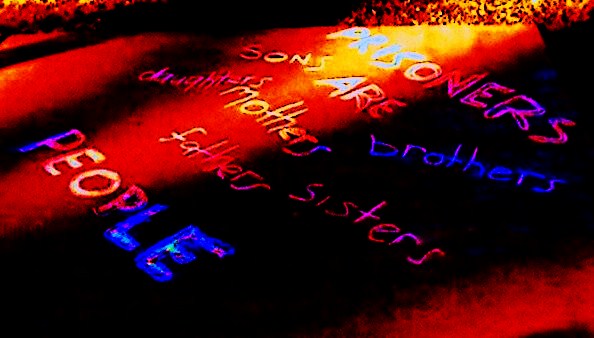
"Prisoners are people, too..."

AZ State Capitol Complex/Wes Bolin Plaza, Phoenix.
(Thanksgiving, 2009)


The above chalking was my holiday gift to the prisoners maintaining state grounds who had to clean up after me last year once I discovered this form of free speech was legal. Feel free to download and distribute - I've made postcards out of it to mail to prisoners, politicians and media alike in the past year. It's still a good present.

The following update comes from the Black Agenda Report yesterday, via Claude at the Freedom Archives' Political Prisoner News list-serve. Both are awesome sources of information about prisoner rights and activism.

Members of the public should continue to call the Georgia DOC numbers below - let them know we're still watching, and that we expect these prisoners to be treated with respect. The rest of us could learn something from their courageous resistance to the brutality and violence of incarceration in America.


-----------------------------------------------


By The Editors
Created 12/15/2010 - 14:40
Submitted by The Editors on Wed, 12/15/2010 - 14:40
Story by Bruce A. Dixon, audio interview by Glen Ford


Georgia prisoners who began a courageous, peaceful and nonviolent protest strike for educational opportunities, wages for their work, medical care and human rights have captured the attention of the world. Black Agenda Report intends to closely cover their continuing story. Glen Ford recorded a conversation with activist Elaine Brown and one of the striking inmates in Georgia on Wednesday, December 15.


Updated story on the strike and support efforts of the newly formed Concerned Coalition to Protect Prisoner Rights below the fold. (hit the Black Agenda Report and click the flash player below the article to listen to the interview).


GA Prison Inmate Strike Enters New Phase, Prisoners Demand Human Rights, Education, Wages For Work


Story by Bruce A. Dixon, audio interview by Glen Ford


The historic strike of Georgia prisoners, demanding wages for their labor, educational opportunities, adequate health care and nutrition, and better conditions is entering a new phase. Strikers remain firm in their demands for full human rights, though after several days many have emerged from their cells, if only to take hot showers and hot food. Many of these, however, are still refusing their involuntary and unpaid work assignments.


A group that includes relatives, friends and a broad range of supporters of the prisoners on the outside has emerged. They are seeking to sit down with Georgia correctional officials this week to discuss how some of the just demands of inmates can begin to be implemented. Initially, Georgia-based representatives of this coalition supporting the prisoner demands included the Georgia NAACP, the Nation of Islam, the National Association for Radical Prison Reform, the Green Party of Georgia, and the Ordinary Peoples Society among others. Civil rights attorneys, ministers, community organizations and other prisoner advocates are also joining the group which calls itself the Concerned Coalition to Protect Prisoner Rights.


Prisoners have stood up for themselves, and the communities they came from are lining up to support them. Today, at a ground breaking for a private prison 300 miles southeast of Atlanta in Millen GA, residents of that local community opposed to the private prison are greeting the governor and corrections brass with a protest. They will be joined by dozens more coming in from Atlanta who will respectfully urge state authorities to talk to the prisoners. We understand that one person there has been arrested. Black Agenda Report will have photos and footage of that event on Thursday.


The broad-based Concerned Coalition to Protect Prisoners Rights fully supports the heroic stand of Georgia's prisoners. “This isn't Attica,” one representative of the coalition explained. “No violent acts have been committed by any of the inmates involved. We hope state corrections officials will be as peaceful and respectful as the prisoners have been, and start a good faith dialog about quickly addressing their concerns.”


Right now, the ball is in the hands of state corrections officials, and reports are that in some of the affected prisons, authorities are fumbling that ball, engaging


“They transferred some of the high Muslims here to max already,” one prisoner told Black Agenda Report this morning. “They want to break up the unity we have here. We have the Crips and the Bloods, we have the Muslims, we have the head Mexicans, and we have the Aryans all with a peaceful understanding, all on common ground. We all want to be paid for our work, and we all want education in here. There's people in here who can't even read...


“They're trying to provoke people to violence in here, but we're not letting that happen. We just want our human rights.”


The transfers are intended to deprive groups of leadership and demoralize them. In some cases they may be having the opposite effect, stiffening prisoner morale and making room for still more leaders to emerge.


“The prisoners insist that punitive transfers are an act of bad faith, the opposite of what we should be doing,” said Minister Charles Muhammad, of the Nation of Islam in Atlanta. “The coalition supports them and demands no punitive transfers, either within or between institutions, and absolutely no transfers to institutions outside Georgia.”


Members of the public should continue to call the prisons listed below, and the GA Department of Corrections and the office of Georgia's governor, Sonny Perdue. Ask them firmly but respectfully to resolve the situation non-violently and without punitive measures. Tell them you believe prisoners deserve wages for work and education. Ask them to talk to prisoners and the communities they come from. It's simple. With one in twelve Georgia adults in jail or prison, parole or probation or other court and correctional supervision, prisoners are us. They are our families. They are our fathers and our mothers, our sons and daughters, our nieces and nephews and aunts and uncles and cousins.


Most prisoners will be back out in society sooner, not later. It's time for us all to grow up and realize that warehousing, malnourishing, mistreating and abusing prisoners does not make us safer. Denying prisoners meaningful training and educational opportunities, and forcing them to work for no wages is not the way to do. It's time to fundamentally reconsider prison as we know it, and America's public policy of mass incarceration.


Bruce Dixon and Glen Ford are reachable at bruce.dixon(at)blackagendareport.com and glen.ford(at)blackagendareport.com, respectively. Black Agenda Report intends to provide ongoing coverage several times per week of the ongoing struggle of Georgia prisoners.


The Georgia Department of Corrections is at http://www.dcor.state.ga.us and their phone number is 478-992-5246


Macon State Prison is 978-472-3900


Hays State Prison is at (706) 857-0400


Telfair State prison is 229-868-7721


Baldwin State Prison is at (478) 445- 5218


Valdosta State Prison is 229-333-7900


Smith State Prison is at (912) 654-5000


---------------------------------------

Freedom Archives
522 Valencia Street
San Francisco, CA 94110

415 863-9977


www.Freedomarchives.org

Questions and comments may be sent to claude@freedomarchives.org